McCarthy Tribunal Decision
PatientsCann UK | What the McCarthy Tribunal Decision Really Says Skip to content News & Analysis Workplace Rights Driving & the Law What the McCarthy tribunal decision really says about medical cannabis, driving and work Reduced to a headline, this case looks like a ruling that medical cannabis patients cannot work or drive. That is not what the tribunal decided. Here is what the judgment in Miss L McCarthy v Kirklees Metropolitan Council actually found, and what it means for patients and employers. PatientsCann UK News & Advocacy Employment tribunal analysis On this page Context Not a blanket ban Treated differently? Missing information Occupational health Where it went wrong The wider lesson The reporting problem Bottom line Letter template References Please note This article is general information and analysis of a published employment tribunal decision. It is not legal or medical advice. If you face a workplace or driving issue involving your prescription, seek advice specific to your circumstances. Why this matters Not a blanket ban The tribunal did not find that patients are automatically unfit to work or drive. A narrow question It was about one claimant, in a safety-sensitive role, against a specific background. Misreported Headlines framing this as “cannabis means you cannot work” distort the judgment. Background Context: why this case has caused concern At first glance, the tribunal decision in Miss L McCarthy v Kirklees Metropolitan Council looks like exactly the sort of case the medical cannabis community has feared: a patient has a lawful medical cannabis prescription, wants to return to work, and the outcome appears to suggest that medical cannabis use means you cannot safely work or drive as part of your job. Read through that lens, and reduced to a newspaper headline, it is easy to see why people are worried. But that is not what the tribunal actually decided. The important distinction is that the tribunal did not find that medical cannabis patients are automatically unfit for work or unable to drive. It found that, in this particular situation, the employer was entitled to pause and seek further information before allowing a full return to normal duties, because the job involved vulnerable service users and some driving, and because the employer did not yet have enough role-specific and prescription-specific information to complete its safety assessment. The claimant had a diagnosis of Emotionally Unstable Personality Disorder / Borderline Personality Disorder, which the employer knew about. She had also experienced a serious mental-health crisis in September 2023, had been admitted to psychiatric hospital, and was absent from work. During this period, she also disclosed previous illegal drug use, including cocaine and cannabis. She later obtained a private medical cannabis prescription, and provided her employer with some information about medical cannabis, including clinic correspondence and external guidance. At around the same time, the employer received a PIPOT safeguarding referral involving alleged aggressive or threatening behaviour reported through NHS and police channels. Because the claimant worked with vulnerable service users, the employer treated this as a significant safeguarding issue and required a further enhanced DBS check. So the tribunal was not looking at a simple question of “can someone prescribed medical cannabis work and drive?” It was looking at a much narrower question: was this employer acting unlawfully when it paused, asked for more information, sought occupational-health advice, considered safeguarding concerns, and managed a staged return to work in this specific set of circumstances? The tribunal answered no. The key point This was not a blanket ban case A central concern is that the decision might create a precedent that employers can say “there is not enough information about medical cannabis, so we cannot safely let you drive.” But that is not what the tribunal found. The claimant alleged that she was told in April 2024 that she could not drive as part of her duties. The tribunal rejected that allegation. It found that no driving prohibition was imposed. There had been discussion about medical cannabis, driving law, and the statutory defence where medication is prescribed and taken as directed, but the tribunal found the employer did not ban her from driving. That is important. The case does not stand for the proposition that an employer can automatically prevent a medical cannabis patient from driving for work. It stands for the much narrower proposition that, where there are specific safety-related questions, an employer may ask for relevant information before reaching a decision. UK driving law also does not impose a blanket ban on people taking prescribed medicines. GOV.UK explains that a person may drive after taking certain prescribed medicines if they have been prescribed them, have followed healthcare advice, and the medicine is not causing them to be unfit to drive. The lawful position. Not “medical cannabis equals no driving,” but rather: a patient may drive if the medicine is lawfully prescribed, taken as directed, and they are not impaired or unfit to drive. Discrimination argument Why the tribunal did not see this as cannabis being treated differently The claimant argued that the employer had no business asking about her driving while taking prescribed medication, and that other medicines were not treated in this way. The tribunal rejected that argument. It accepted evidence from HR that similar enquiries would be made if any employee’s prescribed medication was suspected to affect their ability to perform their duties safely. This is the crucial distinction. The tribunal did not say “medical cannabis is uniquely risky, so employers can restrict it.” It said, in effect, if any medication may affect safe performance in a particular role, the employer can make proportionate enquiries. That matters because many prescribed medicines can affect driving, judgement, alertness, coordination, or reaction time, for example opioids, benzodiazepines, sedatives, strong painkillers, some psychiatric medications, and other controlled medicines. GOV.UK’s drug-driving guidance is framed around impairment and prescribed medicines generally, not medical cannabis alone. The problem would be different if an employer scrutinised medical cannabis patients but ignored comparable risks from other prescribed medicines. That could potentially
Drug Driving and the Medical Cannabis Defence
Cleared in court: a medical cannabis patient’s drug driving appeal | PatientsCann UK Skip to content Case study R v Saleem Aziz Acquitted Cleared in court: a medical cannabis patient’s drug driving appeal Sal Aziz was stopped by police, charged, and convicted. Then the Crown Court overturned it. Here is what happened, what the law really says, and what it means for patients, police, lawyers, and the courts. PatientsCann UK Drug driving and the medical defence Winchester Crown Court, 10 February 2026 Read the full report (PDF) On this page The story What happened The law Four myths Medical and science The evidence Why it was won What is broken Guidance Case files References This is not legal or medical advice This is a personal account and a public resource, based on real case papers, public reports, and the author’s understanding of the law. If you face a drug driving charge, get advice from a qualified solicitor and your medical team where you can. This case is a strong example, but every case turns on its own facts and evidence. The case at a glance Blood THC 3.6 micrograms per litre of blood, over the 2 microgram limit. Charges Two, under sections 4 and 5A of the Road Traffic Act 1988. Hearings Three court hearings before the right result was reached. Outcome Cleared. The conviction was overturned at the Crown Court. Overview The story in short Sal Aziz is a patient who is legally prescribed medical cannabis. In March 2024, police stopped the car he was driving as friends were being taken home from an event. He passed the roadside alcohol test. He told the officer straight away that he was a prescribed patient. A roadside drug swab showed cannabis, and he was asked to do a set of roadside tasks called a Field Impairment Test. He was arrested. A blood test later showed 3.6 micrograms of THC per litre of blood. The legal limit is 2 micrograms per litre. He was charged under two parts of the Road Traffic Act 1988: section 4 (driving while unfit) and section 5A (driving over the drug limit). The magistrates’ court dropped the section 4 charge but found him guilty of the section 5A offence. He was fined and banned from driving for 36 months. He appealed. On 10 February 2026, at Winchester Crown Court, Sal Aziz was cleared. The prosecution could not prove, beyond reasonable doubt, that his medical defence did not apply. The prosecution had argued his medicine was unlawful because more than 30 days had passed since the prescription, and because it was past its labelled use-by date. The court rejected this. The pharmacist expert, Umesh Chauhan, agreed that the “30 days” idea is best-practice guidance, not criminal law. The judge compared it to drinking milk after its best-before date. Passing the date does not make it unlawful to use. Crown Court reasoning, as described in the report Step by step What happened 1 About seven months before the stop A separate police encounter about his prescribed cannabis caused him serious distress. NHS notes record shaking, anxiety, and a hospital visit. Police contact was a known trigger for his physical symptoms. 2 31 March 2024: the stop On the A303, his car was stopped as part of an operation on vehicles leaving an event. There was no crash and no problem with his driving. The officer noted that he seemed nervous and shaky. 3 The roadside tests The alcohol breath test was negative. The roadside drug swab showed cannabis. He told the officer at once that he was a prescribed patient. He was then asked to do the Field Impairment Test: an eye check, a balance test, walking in a line, and touching his nose. 4 The arrest The officer treated the shaking and balance problems as signs of drug impairment. But these are also listed in his medical notes as symptoms of anxiety. He was arrested and his prescribed cannabis, in its labelled packet, was found. No proper interview about his condition took place. He was released to wait for blood results. 5 The blood result The blood test showed 3.6 micrograms of THC per litre of blood. This was over the 2 microgram limit. Nothing else was found. 6 The magistrates’ court The section 4 (unfit) charge was dropped. He was convicted of the section 5A (over the limit) charge. The court wrongly accepted that the medical defence did not apply because the medicine was “expired” or used beyond 28 to 30 days. He was fined and banned from driving for 36 months. 7 The appeal He appealed to the Crown Court, arguing that the medical defence applied. He brought prescription records, NHS notes, expert pharmacist evidence, and the science on THC. 8 10 February 2026: the result The appeal was allowed. The conviction was overturned. The prosecution had not disproved the medical defence. Plain English The law, in plain words Two parts of the Road Traffic Act 1988 matter here. They ask different questions, and it helps to keep them apart. Section 5A: over the drug limit It is an offence to drive with a named drug above a set limit in your blood. For cannabis, the limit is 2 micrograms of THC per litre of blood. This is a strict offence: the prosecution does not have to prove your driving was actually affected. The limit is set by the Drug Driving (Specified Limits) (England and Wales) Regulations 2014. Section 4: unfit through drugs This is a different offence. Here the prosecution must prove that your driving was actually impaired, and that a drug caused that impairment. This usually rests on observations, the Field Impairment Test, and expert evidence. The medical defence (section 5A(3)) If you are a lawful patient, you have a defence to the section 5A offence. You need to show three things. 1 It was prescribed or supplied for a medical reason For a medical or dental purpose. Self-medication or illegal use does
Care Before Discrimination
PatientsCann UK | Patient coalition appeal over plans to restrict CBD Press release Patient rights Patient groups across Europe launch an appeal over plans to restrict CBD A group of patient organisations, including PatientsCann UK®, has launched a public appeal and petition. They are worried about plans in the Czech Republic to treat CBD as if it were a chemical used to make illegal drugs. Their message is short: share the evidence, talk to the patients affected, and decide in the open. Sign the appeal PatientsCann UK® Coalition press release Prague, 17 June 2026 On this page In short Why it matters What we are asking Sign the appeal About the coalition References PatientsCann UK® is one of eight patient organisations in this coalition. The coalition campaigns on health policy and patient rights. It does not sell, promote, or link to any CBD product. In short What is happening Patient groups across Europe and beyond have launched a public appeal and petition called Care Before Discrimination is a Human Right. The worry Czech officials may treat CBD as a drug precursor, a chemical used to make illegal drugs, and limit how it can be handled. Not a ban on rules The coalition backs safety testing, honest labels, age limits, and real action against dangerous products. The ask Share the evidence, talk to the patients affected, and decide openly. You can add your name to the appeal. The background Why it matters CBD (cannabidiol) is a substance from the cannabis plant. It does not make a person feel high. On its own, it is not controlled under the main international drug laws. A purified CBD medicine is already approved across the European Union to treat severe forms of epilepsy, a condition that causes seizures. Because of this, the coalition says a sweeping restriction needs strong evidence behind it. It points to the International Narcotics Control Board, the United Nations body that watches drug controls. By that board’s own account, the proof that CBD is used to make illegal lab-made cannabinoids is limited. There is also a practical worry. The products that are truly risky are synthetic and semi-synthetic cannabinoids, which are part or fully man-made cannabis-like chemicals, often sold through grey-market channels. These need direct enforcement, age limits, and quality rules. The appeal is published just hours before the Czech Government’s Council for Addiction Policy meets on the afternoon of 17 June 2026. The unintended risk. If safe, tested CBD is pushed out of legal shops, demand will not disappear. It will move to an unregulated market, where contamination with heavy metals, pesticides, and solvents is far harder to catch. Patients aren’t asking for a loophole. We’re asking not to be pushed into the shadows. If the Government believes CBD should be restricted, show the evidence, listen to the patients it affects, and explain why the rules we already have aren’t enough. Care before discrimination means deciding in daylight. Pavel Kubů, KOPAC (Patient Association for Cannabis Treatment), Czech Republic What the coalition supports Clear quality standards. Testing for harmful substances. Honest labelling. Age limits. Real enforcement against dangerous synthetic products. What it is not asking for This is not a campaign against regulation, and it is not a request for a loophole. What the coalition objects to is a quiet, paperwork-only shortcut that rests on evidence no one has published. The appeal What we are asking The appeal calls on the Czech Government, European Union institutions, and United Nations drug-control bodies to: 1 Publish the evidence Share the proof before any CBD restriction is brought in. 2 No quiet shortcuts Avoid hidden or paperwork-only measures that skip public scrutiny. 3 Respect patient choice Respect patients’ freedom, dignity, and right to make informed decisions. 4 Regulate, do not ban Set fair and measured rules rather than a blanket prohibition. 5 Target the real risk Aim enforcement at dangerous synthetic and semi-synthetic products. 6 Consult patients first Talk to patient organisations before decisions are made. Add your name to the appeal The petition is open now. The full appeal, the evidence behind it, and the press kit are on the campaign site. The appeal is published in six languages. Sign the appeal Read the full appeal Who we are About the coalition Care Before Discrimination is a Human Right is an open coalition of patient organisations, with more joining. It campaigns on health policy and patient rights, and it does not promote, sell, or link to any CBD product. The appeal’s full title is “Care Before Discrimination: Patients’ Rights and the Proposed Restriction of CBD”. Aube Canada Centrum Paraple Czech Republic Dosemociones Spain Fuck Cancer Czech Republic HARP, Human Application Research Program Czech Republic KOPAC Czech Republic PatientsCann UK® United Kingdom Verein Medcan Switzerland Coalition media contact media@cbdhumanright.org Spokespeople are available in English, Czech, Spanish, French, German, and Italian. The team replies within a working day, and faster around procedural deadlines. PatientsCann UK® press press@patientscann.org.uk For media enquiries about PatientsCann UK® and our part in the coalition. Note The appeal is available in six languages (English, Czech, Spanish, French, German, and Italian) on the campaign site and in the downloadable press kit. In the Kanavape case, the European Union’s top court held that a member state may not ban the sale of CBD lawfully produced in another member state unless a restriction is necessary and proportionate, meaning fair and no more than is needed. The CBD in that case was produced in the Czech Republic. HHC, a semi-synthetic cannabinoid, was added to Schedule II of the 1971 Convention on Psychotropic Substances by the United Nations Commission on Narcotic Drugs. The decision took effect on 6 December 2025. The primary sources behind the appeal are listed in full below. References References follow the Harvard style. Sources with no named author are listed by the responsible body. All links were checked on 17 June 2026. 1World Health Organization (2018) Cannabidiol (CBD): critical review report. Expert Committee on Drug Dependence, fortieth meeting, Geneva, 4 to
MedCan Project: Seeing Stigma Research | PatientsCann UK

Researchers at Liverpool John Moores University (LJMU) want to hear from people in the UK who have a legal prescription for medical cannabis. By taking part, you can help show the world what life is really like as a prescribed patient.
UK-First Inpatient Medical Cannabis Policy
Devon Partnership NHS Trust has formally approved CD21, a Standard Operating Procedure that gives medical cannabis patients a clear, safe pathway to continue their lawful prescriptions while admitted to hospital. Here is what it means for you.
Bedrocan May 2026 Press Release
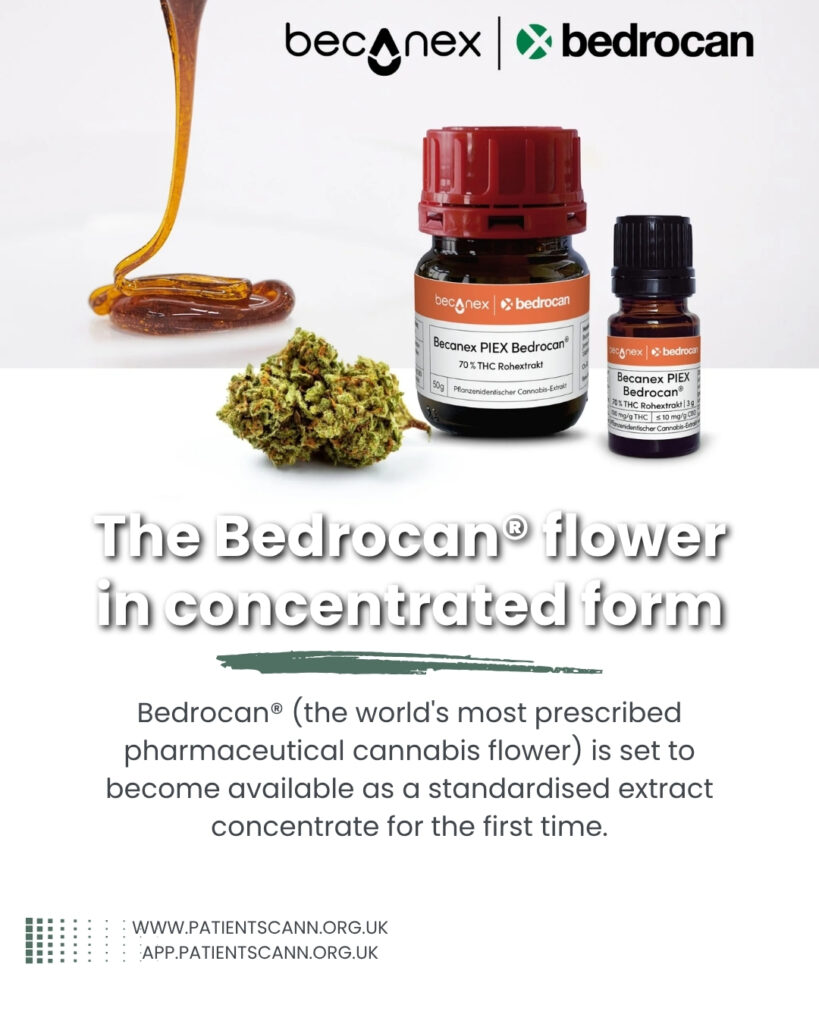
New Bedrocan® Concentrate Opens Up More Ways to Take Your Prescription – PatientsCann UK Skip to main content Industry News · Prescribing Options A trusted flower,now in a new form Bedrocan® — the world’s most prescribed pharmaceutical cannabis flower — is set to become available as a standardised extract concentrate for the first time. For patients, that could mean the same trusted medicine available in more ways than ever before. PatientsCann UK · Industry News · 19 May 2026 Jump to: What Is It? Formulations Why It Matters Timeline 20+ years of Bedrocan® pharmaceutical cannabis production trusted by doctors worldwide 70% THC concentration in the new Becanex PIEX Bedrocan® extract — preserving the full cannabinoid and terpene fingerprint 5+ preparation formats now possible from a single standardised concentrate, from capsules to inhalation 2026 Target launch date for pharmacy ordering across Europe, with Germany as the first market What Is It? The Bedrocan® flower you know — in concentrated form If you have been prescribed Bedrocan® flower, you will know it as one of the most consistent and well-studied pharmaceutical cannabis products available. Grown in EU-GMP-certified facilities in the Netherlands and Denmark by Bedrocan International, it has been the benchmark for standardised medical cannabis for more than two decades. Now, that same product is set to take a new form. Berlin-based extraction specialist Becanex GmbH has developed the Becanex PIEX Bedrocan® 70% THC Concentrate — an extract that, for the first time, brings the full cannabinoid and terpene fingerprint of the Bedrocan® flower into a standardised, pharmacist-ready concentrate. The extract is produced using Becanex’s proprietary PIEX (Plant-Identical Extraction) process, which is specifically designed to preserve what makes a particular cannabis strain therapeutically distinctive. In simpler terms: this is not a generic cannabis extract. It is Bedrocan® in a bottle — the same profile, in a versatile new format. What makes it different from other extracts? Many cannabis extracts are produced to isolate one or two cannabinoids — often just THC or CBD — and discard the rest. The PIEX method takes a different approach, retaining the full spectrum of naturally occurring cannabinoids and terpenes in proportions that match the original flower. Becanex describes this as “a fingerprint” of the source material, and that precision matters clinically: the interaction between cannabinoids and terpenes — sometimes called the entourage effect — is increasingly recognised as relevant to therapeutic outcomes. The result is a concentrate that is both highly potent (at 70% THC) and pharmacologically familiar to doctors and pharmacists who have already been prescribing Bedrocan® flower. “We have always been precise about how we grow our cannabis. Becanex is equally precise about how they extract it. That shared attention to detail is what makes this product worth putting in front of pharmacists, prescribers and patients. The concentrate now enables doctors to prescribe our main product Bedrocan® in multiple compounding formulations.” Jaap Erkelens — CEO, Bedrocan International Formulations More ways for pharmacists to prepare your medicine One of the most significant implications of this product for patients is flexibility. A standardised concentrate that sits in a pharmacy’s dispensary can be compounded into a wide range of preparation formats, tailored to what works best for each individual. The Becanex PIEX Bedrocan® concentrate is specifically designed for the following preparations: Oral solution Capsules Suppositories Topical forms Inhalation dosage Vaporisation What this means in practice for patients For patients currently prescribed Bedrocan® flower, this is particularly significant. If inhalation becomes difficult — whether due to respiratory concerns, lifestyle factors, or simply personal preference — a concentrated extract from the same strain could potentially be offered as an oral or capsule-based alternative, without switching to an entirely different product. The vaporisation option is also noteworthy: the concentrate can be vaporised directly, giving patients an additional inhalation route alongside the flower. This kind of flexibility within a single, consistent product profile is exactly the kind of development that helps both patients and prescribers make evidence-informed adjustments over time. It is important to note that any change to your prescription formulation must always be discussed with and authorised by your prescribing specialist. The availability of a new format does not mean your prescription changes automatically — it expands the options your clinician can consider for you. “Patients who have found a cannabis strain that works well for them shouldn’t have to compromise if they need it in a different form. With Bedrocan as our partner, we can now offer prescribers exactly that — building on a strain they already know and trust.” Sebastian Kamphorst — Director, Becanex GmbH Why It Matters Why standardisation matters for patients Consistency you can rely on One of the greatest frustrations for patients on prescribed cannabis is variability. A standardised extract — manufactured under GMP conditions from a named, controlled cultivar — reduces that uncertainty. You and your prescriber know what to expect. No need to start from scratch For patients and doctors who have already found that Bedrocan® works, this product preserves that relationship. Switching formulation format does not mean re-establishing which strain or cannabinoid profile is therapeutically appropriate. Pharmacist flexibility Compounding pharmacies are central to how many patients receive their prescribed cannabis. A concentrate designed specifically for compounding gives pharmacists more tools to prepare bespoke preparations that suit individual clinical needs. Germany first, Europe next Germany is the first market for the launch, which reflects its position as the most developed regulated medical cannabis market in Europe. UK patients should watch this development closely — it signals the direction of travel for product diversity across Europe. A decade in the making This collaboration is not simply a commercial arrangement — it has roots going back more than ten years. As early as 2014, the founding team behind Becanex worked with Bedrocan under a scientific licence to develop the first extracts from the Bedrocan® flower. At the time, the regulatory framework to bring such a product to market did not exist. Today, it does. Kamphorst reflects on this directly: the team is not
Landmark Ruling for Safety-Critical Role
A medical cannabis patient who was banned from the rail industry for five years after testing positive for THC from his prescribed medication has won a significant victory at the Employment Appeal Tribunal. This ruling changes the legal landscape for every prescribed cannabis patient in safety-critical employment in the UK.
UTAW Passes Major Motion to Protect Workers Prescribed Medical Cannabis
UTAW passes landmark motion to protect workers prescribed medical cannabis. Learn how unions, employers and patients can tackle stigma and discrimination.
PatientsCann UK Statement on NPCC Guidance for Policing Medical Cannabis Patients
PatientsCann UK: NPCC Policing Statement Statement Policing January 2026 PatientsCann UK Statement on NPCC Guidance for Policing Medical Cannabis Patients The NPCC has instructed forces to treat medicinal cannabis patients as “patients first, suspects second.” We welcome this, with important caveats about the gap between guidance and street-level reality. PatientsCann UK·Official Statement·7 January 2026 What the NPCC Guidance Says Officers should treat those in lawful possession as patients first, suspects second People with a valid prescription should be assumed to be patients until proven otherwise A Cancard is not legally required and its absence cannot be used against a patient Our Concerns Significant proportion of officers may still be unaware medical cannabis is legally prescribable Some forces lack internal training or up-to-date briefing materials Guidance on paper does not automatically become consistent street-level practice Why Guidance Is Not Enough Without Understanding It is an ongoing reality that many frontline officers still lack accurate awareness of the legal status of medical cannabis. Independent research has indicated that a significant proportion of officers may still be unaware that medical cannabis can be legally prescribed in the UK, even years after the law changed in 2018. Previous Freedom of Information responses showed that some police forces did not have internal training or up-to-date briefing materials on this subject, leaving officers to rely primarily on older Home Office circulars and personal discretion. This gap between policy and practice raises serious concerns. Unless officers are consistently aware of the legal framework, understand how to verify lawful possession, and are trained to apply the guidance, the lived experience of patients may not improve significantly. On Cancard: The Clarification That Was Needed The NPCC guidance confirms that a Cancard is not legally required for patients with a valid prescription, a vital clarification given the confusion that has surrounded this scheme. Cancard was originally introduced to assist officers in identifying individuals claiming medical need. However, it has always been a discretionary tool, not legal proof of lawful possession. Simply put: A card indicating intent or condition does not change the law. What matters is the prescription. Patients with a valid prescription from an appropriate specialist clinician are in lawful possession, with or without a card. PatientsCann UK’s Position We welcome this guidance as a meaningful step forward, but we call on the NPCC, individual forces, and the College of Policing to follow through with mandatory training, updated force policies, and a clear escalation route for patients who experience non-compliant policing. Guidance without enforcement infrastructure will not protect patients on the ground. PatientsCann UKUK’s Medical Cannabis Patient Organisation · patientscann.co.uk
Help Shape The Future of Medical Cannabis
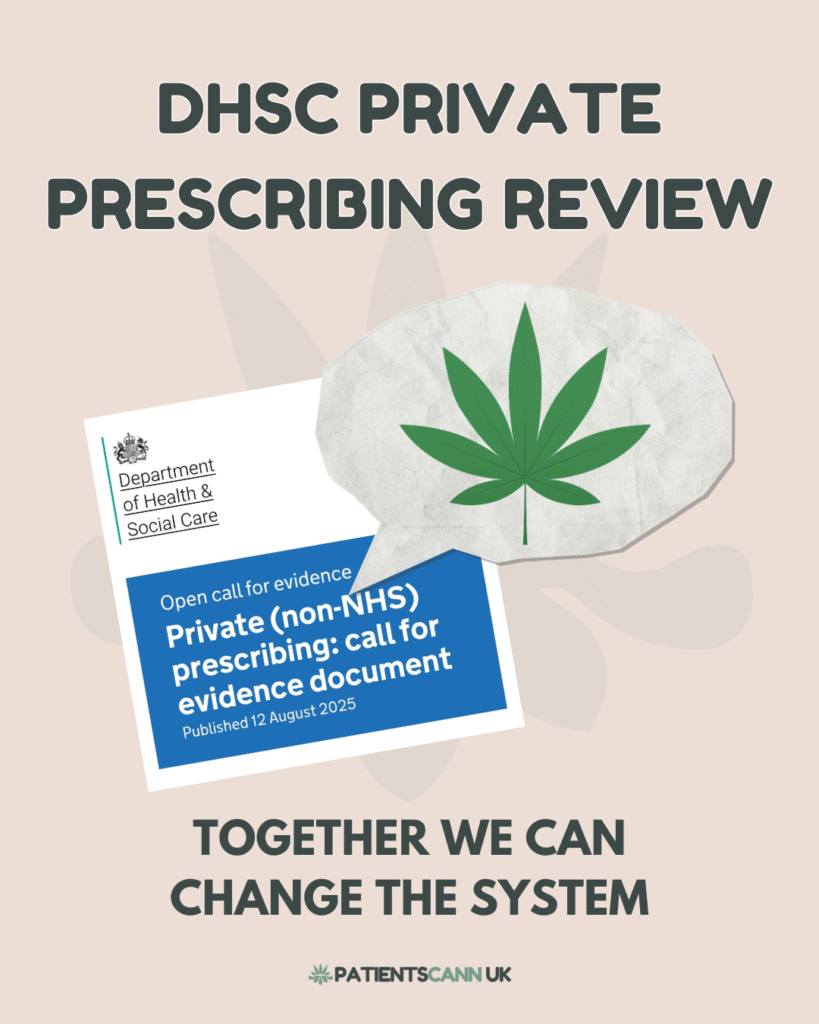
PatientsCann UK — Help Shape the Future Call to Action DHSC Consultation October 2025 Help Shape the Future of Medical Cannabis The Department of Health and Social Care’s Call for Evidence on private prescribing is a rare opportunity to put patient voices at the heart of UK policy. Your experience is evidence — share it. PatientsCann UK·Advocacy·6 October 2025 Why This Matters The DHSC’s “Private (non-NHS) Prescribing: Call for Evidence” could influence how private prescribing works in the UK — including how cannabis-based medicines are accessed, regulated, and supported by clinicians. For thousands of patients, private prescriptions remain the only viable route to accessing the medicine they need. The review invites responses from clinicians, prescribers, pharmacists, healthcare organisations, and patient groups. While the questions are primarily aimed at professionals, it is crucial that patients and carers also share their experiences. Our Position PatientsCann UK believes this review must: Protect the right of patients to access regulated medical cannabis safely and affordably Promote fairness and consistency between NHS and private prescribing pathways Address stigma and empower clinicians to prescribe based on evidence, not fear Encourage more research, education, and evidence-based practice across the medical field For Patients & Carers Share how cannabis medicines have improved your health and quality of life Describe challenges with access, cost, or stigma Explain the reality of navigating private prescribing For Healthcare Professionals Describe prescribing barriers and clinical uncertainties you have encountered Highlight the need for evidence, education, and clearer NHS pathways Share examples of patient impact from restricted access How to Take Part Visit the GOV.UK Call for Evidence page and submit your response. You do not need to answer every question, but you must select Submit at the end for your response to count. Submit Your Evidence Note: This consultation is separate from the ACMD call for evidence on cannabis-based medicinal products. Both reviews are crucial, and we encourage responses to each. Together, they represent an unprecedented opportunity for patients to influence policy at the highest level. PatientsCann UKUK’s Medical Cannabis Patient Organisation · patientscann.co.uk
