Sign The Letter No10
Sign our letter to the Prime Minister | PatientsCann UK® Skip to content Medical Cannabis Awareness WeekOpen letter It’s been legal for 8 years. Stop the hate and fear. We are writing to the Prime Minister to ask him to stand with prescribed medical cannabis patients. Add your name and postcode, and we will hand your signature in to 10 Downing Street on Saturday 7 November. PatientsCann UK®Hand-in: Saturday 7 November 202610 Downing Street, London Add your name Read the letter Download PDF Who it is toThe Rt Hon Andy Burnham MP, Prime Minister What we needYour name and postcode. That is all. When we hand it inSaturday 7 November, at 10 Downing Street The letter The Rt Hon Andy Burnham MPPrime Minister10 Downing StreetLondonSW1A 2AA It’s Been Legal for 8 Years: Stop the Hate and Fear Dear Prime Minister, This week is Medical Cannabis Awareness Week, and we are asking you to stand with prescribed medical cannabis patients across the United Kingdom. Medical cannabis became legal to prescribe on 1 November 2018. Eight years later, legality has still not delivered equality, understanding or meaningful access. Medical Cannabis Awareness Week exists because patients continue to have to explain, defend and fight for recognition of their medicine. Patients are still treated with criminality for taking medication prescribed by specialist clinicians. They are challenged at work, questioned in public, denied access to pubs, venues and community spaces, separated from their medication and repeatedly forced to prove that they are patients, not criminals. The discrimination reaches into every part of life. Patients face workplace drug-testing and zero-tolerance policies that may fail to distinguish prescribed treatment from illicit use. Some fear complaints, eviction or homelessness because landlords and housing providers misunderstand their medication. Others are refused entry to pubs, social clubs, entertainment venues, sporting events and the very community spaces that should protect people from loneliness and isolation. They face uncertainty while driving, travelling and interacting with the police. They encounter misunderstanding within hospitals, care homes and other health and social-care settings. Some are unable to administer their prescribed treatment or find that lawful medication is viewed as a behavioural, safeguarding or illicit-drug concern rather than part of their healthcare. For people who rely on adult social care, the consequences can be especially profound. They may depend on carers, supported accommodation, residential services or local authorities to respect and facilitate their prescribed treatment. Poor understanding can interfere not only with medication, but with a person’s autonomy, dignity, independence and ability to remain connected to their community. You have spoken powerfully about creating a social-care system founded on dignity, security and support. You have also emphasised the importance of listening to lived experience and bringing government departments together rather than allowing people to be passed around a fragmented system. Medical cannabis patients need those same principles applied to them. Too many people who might benefit from treatment remain unable to access it through the NHS. They must pay privately or go without. This creates a cruel divide between those who can afford lawful treatment and those who cannot, while patients already prescribed privately may find that other parts of the health and care system do not understand or properly recognise their prescriptions. Behind every failure is a person. A worker afraid to disclose their prescription. A tenant frightened that misunderstanding could cost them their home. A social-care user whose treatment is questioned or disrupted by those responsible for supporting them. A patient turned away from a pub, social club or community venue and cut off from ordinary social life. A driver anxious that lawful medication may be misunderstood at the roadside. A disabled football supporter uncertain whether they will be admitted with their medicine. A family paying privately because meaningful NHS access remains beyond reach. A patient who has followed the law but is still made to feel ashamed. You recently argued that it was unfair for football supporters to be singled out and prevented from consuming alcohol in sight of the pitch when supporters of other sports are treated differently. You called for outdated assumptions to be reconsidered and described the unequal treatment of football supporters as discriminatory. We urge you to apply that same principle of fairness to patients. Alcohol is a recreational product. Medical cannabis is prescribed medication. If football supporters’ ability to drink alcohol deserves national debate, disabled patients being denied entry, prevented from carrying medication or forced to choose between treatment and participation demands attention too. The same principle applies to pubs and community spaces. These are not merely commercial venues. They are places where friendships are maintained, loneliness is reduced and communities come together. A patient should not be excluded from them because staff or security do not understand a lawful prescription. Nor should a person’s medication contribute to housing insecurity or homelessness. Nobody should fear losing their accommodation because a landlord, housing officer or support provider mistakes prescribed treatment for illicit drug use. These are not separate problems. They are connected expressions of the same failure to recognise patients as patients. The person challenged at a football turnstile may already have faced discrimination from an employer, landlord, police officer, healthcare professional, social-care provider or pub door staff. Patients should not have to renegotiate the legitimacy of their medication in every workplace, home, hospital, care setting, stadium and community space they enter. The consequences are emotional as well as practical. People withdraw from employment, healthcare, and community life. Some alter or interrupt their treatment because they fear confrontation. Others experience financial hardship, housing insecurity, worsening health, damaged relationships and profound isolation. Enough is enough. It’s Been Legal for 8 Years: Stop the Hate and Fear. We are urging you to: Publicly recognise medical cannabis patients as patients, acknowledging the stigma, exclusion, financial pressure and institutional barriers they continue to face. Meet medical cannabis patient groups and people with direct lived experience, including patients affected by barriers in employment, housing, homelessness services, social care, healthcare, driving, policing, sport, pubs
Medical Cannabis Awareness Week 2026
Our plan for Medical Cannabis Awareness Week 2026 | PatientsCann UK® Skip to content MCAW 20261 to 7 NovemberEight years of legal prescribing Our plan for Medical Cannabis Awareness Week, day by day Eight years after medical cannabis became legal to prescribe in the UK, we are taking the patient voice to race tracks, patient lounges, a public pop-up and No. 10 Downing Street. Pick a day, save the events you like, and add them to your calendar. –Days –Hours –Minutes –Seconds until MCAW 2026 begins on Sunday 1 November. See our planJoin our DiscordThe whole weekAdd your event PatientsCann UK® at MCAW 2026 Where we will be Our aim is to bring patients together, take accurate information into public spaces, help Drive Out Cannabis Stigma and show that prescribed patients belong everywhere. You do not need to come to the whole week. Some details are still being confirmed, so check back here. Help choose our pop-up On Thursday 5 November, the public picks where the PatientsCann UK® team holds an awareness pop-up. Fill in our short form to tell us where you would like us to go. For updates through the week, join our Discord to meet other patients from anywhere in the UK. It is a safe, moderated space and free to join. Choose the place →Join our Discord Want to help on the day? Our volunteers welcome patients, share resources and help capture the week. Become a volunteer and we will send you a full briefing. MCAW belongs to everyone The whole week at a glance Other groups are running their own events too. Here is what PatientsCann UK®, United Patients Alliance and MCUK have shared so far. Tap any event to see the details. Saved events are shaded, and anything that overlaps with another saved event is flagged. Running something yourself? Add your event. ShowPatientsCann UK®United Patients AllianceMCUK MCUK’s programme runs from Monday 2 to Sunday 8 November. Sunday 8 November falls outside the usual 1 to 7 November week. Other MCAW 2026 programmes What United Patients Alliance and MCUK are planning United Patients Alliance MCUK United Patients Alliance (UPA) is running a theme for each day of the week, starting with patient stories on 1 November. Session times have not all been shared yet. See the UPA MCAW page. MCUK is running evening sessions from Monday 2 to Sunday 8 November, with an extra afternoon session on Thursday 5 November. All times are UK time. MCUK says the speakers and panel line-ups are still being finalised, so there may be small changes to the session descriptions. Your event Running something for MCAW 2026? Add it to this page MCAW belongs to the whole community, and nobody needs permission to take part. If you are running an event or activity between 1 and 7 November, big or small, in person or online, tell us about it. We will check the details and add it to the week at a glance so more patients can find it. Your name Email Group or organisation (optional) Event name DayChoose a daySunday 1 NovemberMonday 2 NovemberTuesday 3 NovemberWednesday 4 NovemberThursday 5 NovemberFriday 6 NovemberSaturday 7 NovemberMore than one day Time (if known) How will people join? In personOnlineBoth Venue address, or online link What is happening? Website or social media link (optional) I agree to PatientsCann UK® storing these details so they can contact me about this event. I agree to the event name, day, time, place and description being shown on this page and shared on PatientsCann UK® social media. My name and email will not be published. Send my event Thank you. We have your event and will check the details before adding it to this page. Remember to share it with #MCAW and #MCAW2026. My week 0 My week Close Add all to my calendar
Medical Cannabis Awareness Week
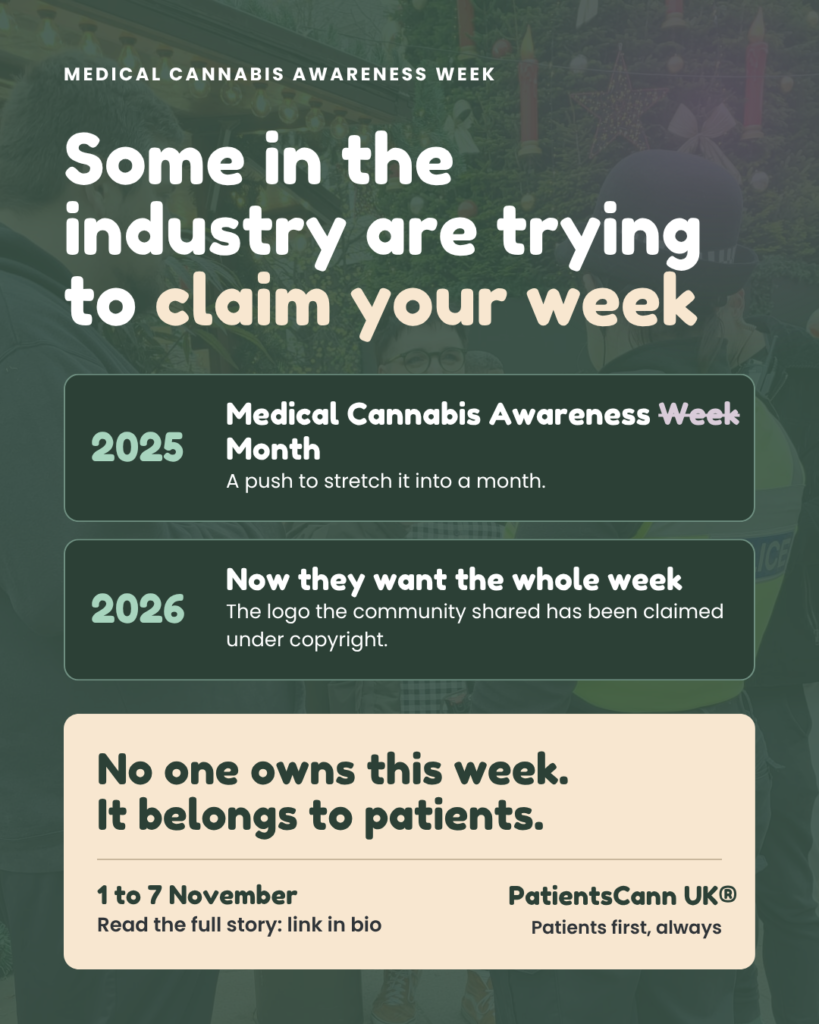
Medical Cannabis Awareness Week 2026: a week that belongs to everyone | PatientsCann UK® Skip to content Awareness1 to 7 November 2026Community owned Medical Cannabis Awareness Week belongs to everyone Every year, from 1 to 7 November, patients, carers, families and supporters across the UK speak up about medical cannabis. No one owns the week. It is run by the community, for the community, and anyone can take part. PatientsCann UK®Awareness#MCAW #MCAW2026 See this year’s eventsJoin our Discord On this page What is MCAW? A week for everyone The logo Why a week Our tours This year Get involved References At a glance When1 to 7 NovemberThe first week of November, every year. Why then1 November 2018The day medical cannabis became legal to prescribe in the UK. Who owns itNo oneIt is community owned and community run. Everyone is welcome. Join in#MCAW2026Share your story, host an event, or simply talk about it. Where it began What is Medical Cannabis Awareness Week? Medical Cannabis Awareness Week, often shortened to MCAW, is a yearly week of events, stories and conversations about cannabis as a medicine. It starts on 1 November. That date matters. On 1 November 2018, medical cannabis became legal to prescribe in the UK.2 The week was first started in 2020 by PLEA (Patient-Led Engagement for Access), a patient advocacy group.1,4 Patients shared their stories, doctors and advocates joined online panels, and people across the UK were asked to talk about medical cannabis with friends and family.1 In 2023, the week marked five years since medical cannabis became legal to prescribe, and ran from 1 to 7 November as it does every year.4 By then, PLEA had closed. The week could have faded away. Instead, the community picked it up and carried it on. Patients, volunteers and small groups kept the week alive, and PatientsCann UK® stepped in to help it grow. Community owned A week that belongs to everyone No person, company or group owns Medical Cannabis Awareness Week. It belongs to every patient who has ever had to explain their medicine. PatientsCann UK® MCAW has always been bigger than any one organisation. It grew because patients wanted it and because people gave their time for free. When the group that started it closed, the week did not close with it. That tells you who it really belongs to. Nobody needs permission to take part. You do not need to sign up to anyone, pay a fee or use a set logo. A patient talking to their GP, a family sharing a story online, a clinic holding an open day, a local group meeting in a cafe: all of these are Medical Cannabis Awareness Week. We think it should stay that way. PatientsCann UK® takes part every year, and we will keep doing so, but the week is not ours. It is yours. What MCAW is Community owned and community run. Free for anyone to join, share and take part in. Led by patients, their carers and their families. A shared moment, every 1 to 7 November. What MCAW is not Not owned by any person, company or organisation. Not something anyone needs permission to take part in. Not a brand or a product to sell. Not closed to anyone who wants to help. Free for everyone The MCAW logo, and yours These are the logos PatientsCann UK® uses for Medical Cannabis Awareness Week. We first used our logo in 2024, together with United Patients Alliance and the Medical Cannabis Patients Alliance (MCPA), a patient group that has since closed. We added two more for 2025. All of our logos are in the public domain. There is no copyright on them. Anyone can download them, print them, share them or change them, with no need to ask. After PLEA closed, the original MCAW logo was shared by patients, groups and businesses across the community. That logo has since been claimed under copyright. We do not think any symbol of this week should belong to one organisation, so ours are free for all. 2024 logoPublic domain. Free for anyone to use.Download 2025 logo, lightPublic domain. Free for anyone to use.Download 2025 logo, darkPublic domain. Free for anyone to use.Download Make your own. We would love to see how you picture Medical Cannabis Awareness Week. Design your own MCAW logo, share it on social media, tag PatientsCann UK® and use the hashtags: #MCAW#MCAW2026 Keeping it focused Why a week works better than a month Last year, some in the industry suggested a Medical Cannabis Awareness Month. It did not get off the ground, and we did not support it. A longer campaign sounds bigger, but it would take away the impact of the week. One loud moment. When everyone speaks up in the same seven days, the message is heard. Spread across a month, the same voices get lost. It fits patients. Many patients live with pain, fatigue or long-term illness. A week is something people can manage. A month is a lot to ask. It keeps the anniversary at the centre. The week starts on 1 November, the day medical cannabis became legal to prescribe. That link is part of what makes it meaningful. It stays about patients. A short, focused week keeps the attention on real people and real stories. What we have done On the road every November since 2023 PatientsCann UK® first took Medical Cannabis Awareness Week on the road in 2023, with a trial tour of Brighton, Hove and Exeter. Since 2024, we have followed a set route from Northern Ireland to London. We travel the whole of the UK, so that patients in every nation have a chance to meet us, ask questions and feel less alone. In 2024, the tour took patient advocates to Belfast, Glasgow, Birmingham, Cardiff and London.3,5 Where we can, we also join other events along the way. 1Northern IrelandWe start the week in Northern Ireland. 2ScotlandThen across the water to Scotland. 3The middle of EnglandDown to the heart of
What Lucy McCarthy Told Us
PatientsCann UK | What Lucy McCarthy told us Skip to content Patient interview Workplace Rights In her own words What Lucy McCarthy told us A tribunal judgment records findings. It does not record what the year felt like for the person at the centre of it. After the decision in her case was published, Lucy McCarthy spoke to PatientsCann UK, and asked us to share what happened so that other patients might be spared some of it. PatientsCann UK News & Advocacy Patient interview On this page Her account What she would change For patients Support References How to read this page This is a first-hand account, given to PatientsCann UK directly by Lucy McCarthy and published with her consent. It is her recollection. We have not independently verified it, and in places it differs from what the employment tribunal found. Where it does, we say so. The published judgment remains the legal record of the case. Nothing here is legal or medical advice. In her own words What happened, as Lucy describes it Her account The job she was doing Lucy worked for the council as a work coach for young people aged 18 to 25 who are autistic or have ADHD. It was support work, built on trust and continuity with young people who often find both hard to come by. Her account Driving was not part of the role This is where her recollection and the tribunal’s description part company most clearly. Lucy says her job carried no driving requirement at all. Most journeys between work locations were walkable, so she generally walked, and she occasionally used her own vehicle during working hours. By the time she went off sick, carrying service users in an employee’s own vehicle was completely prohibited in any case. She also says there were no legal restrictions stopping her from driving while taking prescribed medical cannabis, provided she was unimpaired, and that she held the appropriate business insurance. She had explained to her employer that, as with any other medicine, she was the person legally responsible for deciding whether she was impaired and fit to drive. The tribunal, on the evidence before it, described a role involving some driving around the district and occasionally transporting service users, and treated that as part of why the employer was entitled to ask for more information. Lucy’s position is that the driving element was incidental, personal and small, and that it became the centre of a case it never really belonged in. Her account Depression came first Around August her depression became severe. During that period she used cocaine and became dependent on it, and she is candid that it sent her into a spiral. She did not hide any of it. She talked to colleagues about what was happening to her, and as she describes it now, she was asking for help. Depression, not cannabis, was the thread running through everything that followed. She spent time in and out of hospital and care. Through all of it, she says, she wanted to get back to work, and she did everything she could think of to make that possible. Her account What she handed over, and when they asked for more In November 2023 she gave her line manager the clinic’s initial consultation letter, along with supporting information and research she had gathered herself. She had not yet accessed the clinic’s online portal, so she did not have the prescription itself to give them. Nobody asked her for the prescription, or for any further documents, until February 2024. That was more than three months later, and by then she had already started the grievance and ACAS process. Her account is that the paperwork she did provide was not passed on to anyone else, and that the delays and repeated requests grew out of that gap rather than out of any refusal on her part. Her account Four Employee Healthcare assessments in about four months She was assessed four times over roughly four months. As she describes the sequence: She was extremely low and suicidal, and struggling to manage her emotions. This was around the time she admitted herself to a psychiatric hospital. Her anxiety and depression scores had improved a great deal. She was fit to return and wanted to, but was kept off because of concerns about her cannabis use, and because she was not engaging with NHS treatment she did not think was right for her. She was again found fit to return, but the report was said not to contain enough detail about the cannabis for her employer’s purposes. She was again found fit to return, and this time the report went into more detail about the cannabis, including the strain, the strength and its effects. Three of the four assessments found her fit for work. What kept changing, on her account, was how much detail her employer wanted about the medicine rather than anything about her ability to do the job. Her account Two months lost trying to get back From February to April, while she was trying to return to work, her employer sought to make not driving during working hours a condition of her return, including in a formal risk assessment. Lucy declined that condition. She says the standoff delayed her return by around two months. She was eventually allowed back in April, and allowed to drive during working hours. Her account Other medicines, handled differently Her employer already knew she had been taking other medicines that can cause impairment, including the antipsychotics aripiprazole and risperidone. On her account, none of that led to an Employee Healthcare referral, a restriction on her driving, or a risk assessment about driving at all. The contrast is central to how she understands what happened. The same concern, applied consistently, would have been raised about the earlier medication too. Her account Still waiting on the right diagnosis Alongside all of this she was untangling her own medical history. Her formal diagnosis is
Why a motorsport team sponsored a motorsport team
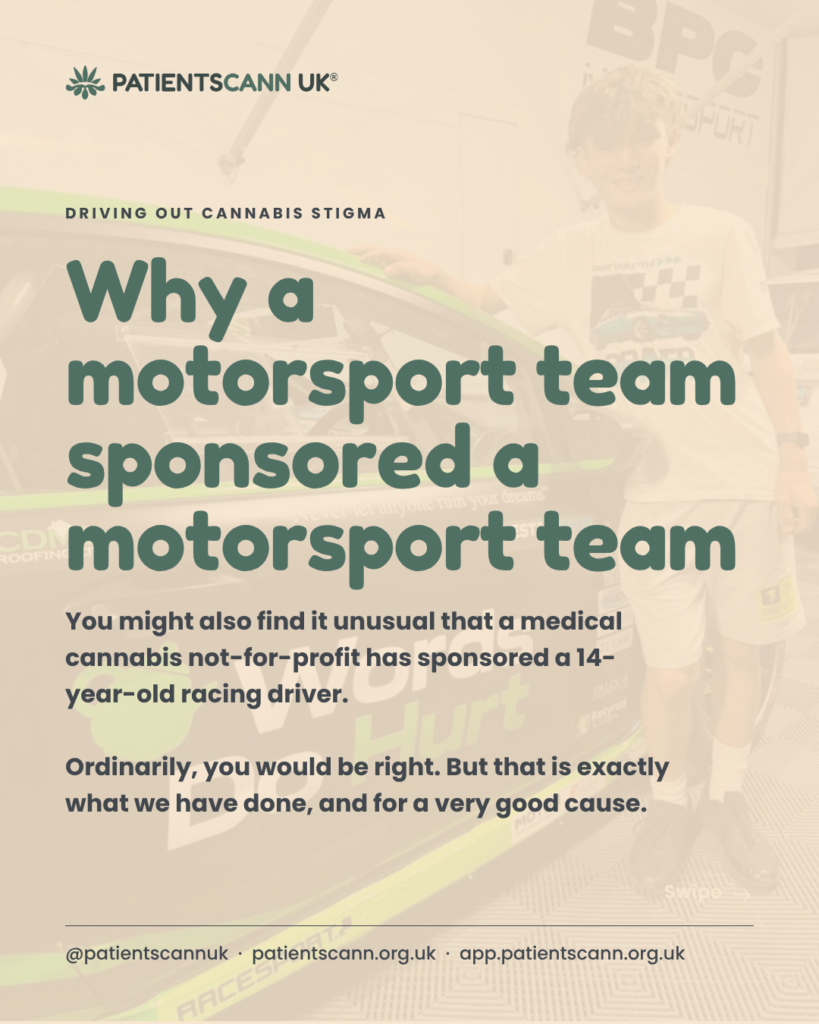
Why a Motorsports Team Sponsored a Motorsport Team | PatientsCann UK® Skip to content Sponsorship Words Do Hurt Driving Out Cannabis Stigma Why a Motorsports Team Sponsored a Motorsport Team You might find it unusual for one motorsports team to sponsor another motorsport team. By PatientsCann UK® Motorsports Team Thomas Potter Racing Words Do Hurt Words Do Hurt campaign On this page Thomas Potter Racing Words that hurt patients Why we chose to support More than sponsors Best of luck, Thomas References You might also find it unusual that a medical cannabis not-for-profit has sponsored a 14-year-old racing driver. Ordinarily, you would be right. But that is exactly what we have done, and for a very good cause. The driver Introducing Thomas Potter Racing Thomas Potter is a 14-year-old racing driver competing in the Fiesta Junior Championship, following a successful karting career that included more than 100 race wins and six championships. However, Thomas Potter Racing is about far more than results on the track. Thomas has used his growing motorsport platform to support children and adults affected by bullying and poor mental health. His experiences inspired the Words Do Hurt campaign, which has been raising awareness of bullying, mental health and the importance of asking for help since 2020. Thomas experienced negativity, abuse and hurtful comments while pursuing his motorsport ambitions, including criticism linked to competing on a limited budget. Rather than allowing those experiences to drive him away from the sport he loved, he used them to help others who were going through similar situations. The campaign carries a simple but powerful message: Words do hurt. Words Do Hurt campaign Names added to the Words Do Hurt race car, Thomas Potter Racing. A Words Do Hurt campaign message: bullying costs lives. That message is displayed through Thomas’s racing, campaign vehicles, event appearances and work within the community. The project aims to use motorsport to start conversations in schools, colleges, race paddocks and community spaces about bullying, mental health and kindness. Thomas also invites people affected by bullying to add their names, or the names of people they want remembered or represented, to his vehicles. In doing so, every name becomes part of the campaign and travels with the team. A shared experience Medical Cannabis Patients Know That Words Hurt The experiences of medical cannabis patients are obviously different from those of a young racing driver facing bullying. However, the central message of the campaign will feel painfully familiar to many people in our community. Medical cannabis patients know first-hand that words do hurt. Patients can receive negative comments simply because of the medicine they have been legally prescribed. They may be called drug users, addicts or criminals, even when they are following specialist medical advice and using their treatment responsibly. A prescription can be dismissed as an excuse. A patient’s medical condition can be questioned. The smell of prescribed cannabis flower can cause strangers to make immediate assumptions about somebody’s behaviour, character or ability. These are not harmless words. They can make patients afraid to use their medicine in public, disclose it at work or speak honestly about their treatment. They can leave people feeling ashamed of something that is part of their healthcare. PatientsCann UK® exists to challenge those assumptions, provide practical support and ensure patients do not have to face them alone. Our motorsport team carries that mission onto the track by Driving Out Cannabis Stigma, promoting visibility and fair, evidence-based access for legally prescribed patients. The Words Do Hurt campaign and Driving Out Cannabis Stigma come from different experiences, but they share an important principle: Nobody should be defined or driven out of something they love by the words and assumptions of other people. PatientsCann UK® The decision Why We Chose to Support the Campaign When we learned more about Thomas, his racing and the purpose behind Words Do Hurt, supporting the campaign felt entirely natural. This was not about one motorsport team paying to place its logo beside another racing car. It was about two motorsport projects supporting a shared belief that the sport can be used to make people feel seen, represented and less alone. Sal Aziz, founder of the PatientsCann UK® Motorsports Team and Director of PatientsCann UK®, therefore personally funded a sponsorship position to support Thomas Potter Racing and the Words Do Hurt campaign. We are absolutely delighted that PatientsCann UK® Motorsports Team and Driving Out Cannabis Stigma appears on the team’s partners banner. The words “Cannabis Patients” have been added to the TPOT, ensuring that our community is represented alongside others who have been affected by bullying, hurtful language and stigma. The words “Cannabis Patients” added to the TPOT, Thomas Potter Racing. PatientsCann UK® on the Thomas Potter Racing partners banner. Those two words represent thousands of people. They represent patients who have been judged because of a smell. They represent people who have hidden their medication because they feared how others might react. They represent patients who have been excluded from work, volunteering, sport or ordinary public life because somebody saw the word “cannabis” and stopped seeing the person. Having “Cannabis Patients” written on the TPOT is a small but meaningful act of visibility. It says that our community belongs within this conversation and that stigma against patients should never be dismissed as harmless banter. Visibility Motorsport Can Carry More Than Sponsors A racing car usually carries the names of businesses, products and commercial partners. Thomas Potter Racing demonstrates that it can carry something more. It can carry people’s stories. It can carry the names of those who have been hurt. And it can carry a message into paddocks and communities that might otherwise never hear it. The Words Do Hurt campaign uses motorsport as a starting point for conversations about bullying and mental health, and Thomas’s story encourages young people to ask for help and continue pursuing their ambitions. That is something PatientsCann UK® is proud to stand beside. We know from our own work that visibility
Why We Started a Motorsports Team
Why a Medical Cannabis Not-for-Profit Started a Motorsports Team | PatientsCann UK® Skip to content Founder’s story Medical cannabis & motorsport Driving Out Cannabis Stigma Why a Medical Cannabis Not-for-Profit Started a Motorsports Team Before I knew medical cannabis was legal in the UK, motorsport was already my life. By Sal Aziz PatientsCann UK® Motorsports Team Founder’s story Team launch · Thruxton On this page Getting through the gate Becoming a patient When my case became policy Finding another route Why I have to race References One of my earliest racing memories is being told off for swearing after losing on Need for Speed: Underground. In my defence, I was only replicating my father! A few years later, he introduced me to Formula 1 after Lewis Hamilton joined the grid. I began watching properly in 2008 and was immediately hooked, waking at the crack of dawn when needed to see every race live. The highlight was Brazil 2008. My father walked out during the final lap, believing the championship was over, moments before Martin Brundle exclaimed: “Is that Glock?!” I had to scream for him to come back. I wanted to be part of that world, but racing appeared impossibly expensive. Even arrive-and-drive karting was beyond my budget. Then I discovered marshalling. Getting in Getting Through the Gate In 2021, I attended American SpeedFest at Brands Hatch. COVID restrictions meant unusually small crowds, giving the freedom to explore. Watching the marshals made me realise there was no reason I could not join them. I volunteered and was immediately hooked. Driving onto a circuit for the first time, even at 30 mph to reach my post, felt momentous. I was finally part of motorsport rather than watching from behind a screen or spectator fence. I went on to marshal events ranging from grassroots racing at Anglesey to the British Touring Car Championship and Goodwood Festival of Speed. I can even add “told Gordon Ramsay where to park at Goodwood” to my CV. Sal marshalling at Goodwood, as seen on Sky Sports F1. (Image source: Sky UK, used for illustrative purposes under Fair Dealing). “Told Gordon Ramsay where to park at Goodwood.” (Image source: Sky UK, used for illustrative purposes under Fair Dealing). I also competed in car trials, taking my Daewoo Lacetti off-road to see how far it could travel through marked sections. It was not Formula 1, but it was affordable, competitive and enormous fun. Author competing in a car trial (Image source: Woolbridge Motor Club, used for illustrative purposes under Fair Dealing). Treatment Becoming a Patient After a road trip through the Netherlands and an eventual drug-driving investigation in which I was found to be below the applicable limit, despite testing a wide range of cannabis products, I began exploring medical cannabis through the proper clinical route. My initial consultation took place on a Saturday morning at Silverstone before a day of marshalling. Once I began treatment, I noticed immediate improvements. Chief marshals commented positively on my performance. I completed the required health declarations and passed my flag assessment while openly prescribed medical cannabis. Author flag marshalling at the NASCAR Whelen Euro Series (Image source: GP1, used for illustrative purposes under Fair Dealing). Flag marshalling requires concentration, communication and rapid decisions in a safety-critical environment. I performed that role successfully and was excited to return to Goodwood for a second year, this time in the Supercar Paddock. Then a member of the public reported a marshal using cannabis. The report The Report That Began With a Smell I immediately acknowledged that the cannabis was mine and explained that it was legally prescribed for anxiety. I expected that explanation to resolve the concern. Instead, I was removed from post while senior Motorsport UK personnel were contacted. I was eventually permitted to continue in the lower-risk Supercar Paddock while the matter was reviewed. No performance failure or near miss had prompted the intervention. My medicine had become visible because of its smell. An odourless tablet may remain private. Cannabis flower can announce a patient’s treatment before they choose to discuss it. Smell is not evidence of impairment, but it can activate assumptions inherited from cannabis prohibition. That report eventually became much bigger than my individual case. Policy When My Case Became Policy In February 2024, Motorsport UK introduced Version 1 of a new signing-on declaration. It asked officials and marshals to confirm that they did not have disabilities or mental-health conditions, use drugs on the WADA Prohibited List, or take medication that might affect their duties. Motorsport UK later explained that the change followed reports during 2023 involving physical capability, mental health and the “substance use of colleagues”. I recognised myself in two parts of that explanation. Anxiety was my declared mental-health condition. Prescribed cannabis was my treatment, but it was apparently being framed as “substance use”. Although I was not named, the description reflected the defining features of my case. Version 1 of the officials declaration. Version 1 backfired horribly. Disabled volunteers and marshals taking medicines including blood thinners and asthma treatments began questioning whether they were still eligible. Medical cannabis was also independently identified as a problem. Within days, Motorsport UK issued Version 2, returning to a more sensible functional question: did the person’s condition or treatment adversely affect their duties? Version 2 of the officials declaration. But medical cannabis remained explicitly prohibited. My interpretation is that Version 1 attempted to capture cannabis through broad language about mental health, medication, “substance use” and the WADA list without initially announcing a cannabis-specific ban. When that language affected too many other volunteers, it was reversed, but cannabis patients remained excluded. I cannot prove the private intentions of those who wrote the policy. What I can say is that my case was followed by Version 1, the backlash, Version 2 and ultimately a categorical medical cannabis prohibition. Motorsport UK Public UK Licence Suspensions Register. Responsibility The Ban Is Not My Fault, but It Followed My Case I did not ban medical
Race Report Thruxton Retro
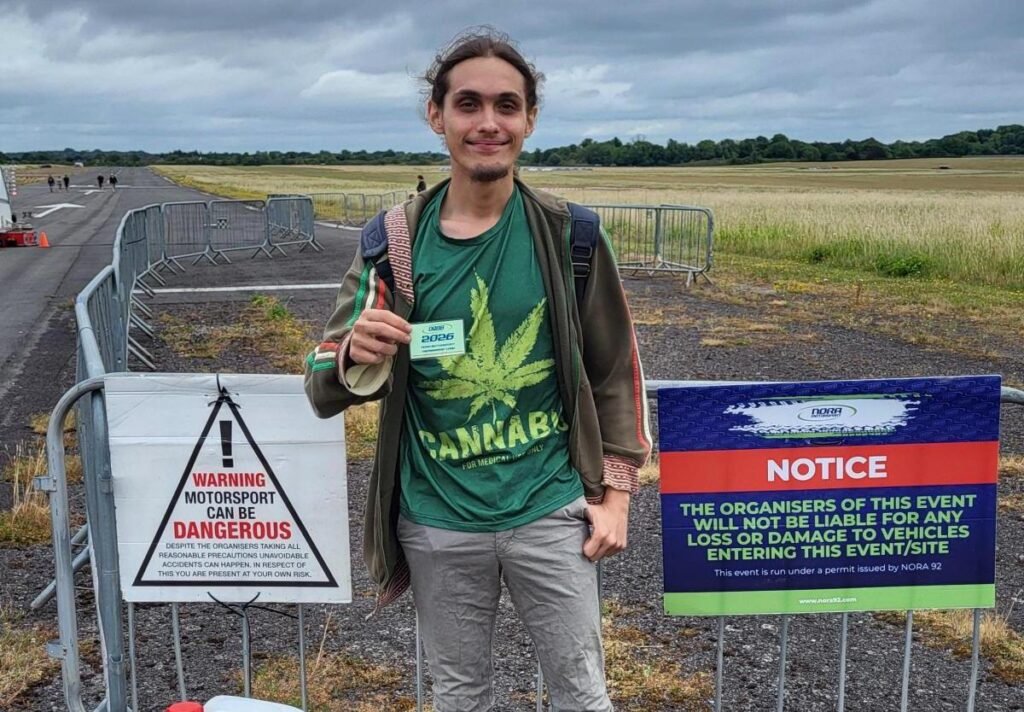
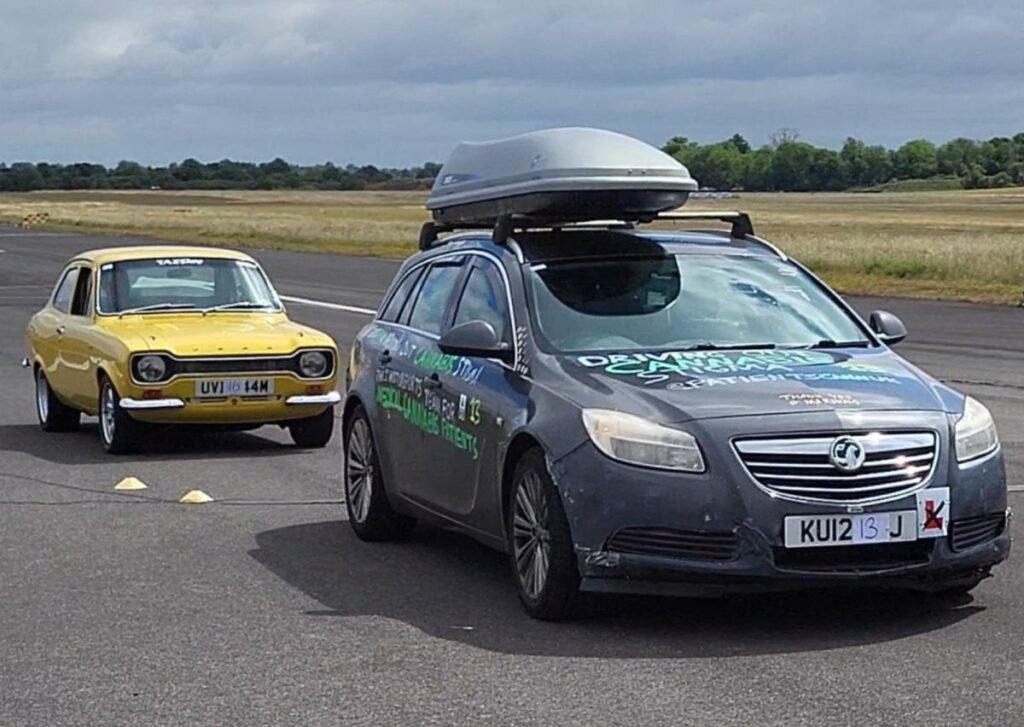
Race Report: Thruxton Retro, 4 July 2026 | PatientsCann UK® Skip to content Race report Thruxton Retro Team launch Race Report: Thruxton Retro, 4 July 2026 The PatientsCann UK® Motorsport Team successfully launched at Thruxton Retro on 4 July 2026, with founder Sal Aziz completing 15 drag-racing runs in his Vauxhall Insignia estate. By PatientsCann UK® Motorsports Team Race report Thruxton, 4 July 2026 15 runs completed On this page Preparing the car Arrival at Thruxton A green light Racing through the middle Fifteen runs Just the beginning References After securing a NORA Motorsport licence with his medical cannabis prescription declared, Sal immediately began looking for an opportunity to return to competitive motorsport. Thruxton was the natural choice. It was the circuit where Sal had first entered motorsport as a marshal, making it the perfect place to relaunch his motorsport career from behind the wheel. The build Preparing an Unlikely Race Car Preparation for the event was suitably grassroots. Sal crudely applied a cannabis-themed livery to his Vauxhall Insignia estate before we posted a teaser on social media. Despite the appearance, we were generating attention before the car had even reached the start line. The teaser: a cannabis-themed livery applied to the Vauxhall Insignia estate. Livery detail: a sports team for cannabis patients. The Insignia was not built for drag racing. It is a diesel estate, complete with a roof box, rather than one of the specially prepared machines normally associated with the drag strip. The team knew the Insignia was unlikely to be competitive against dedicated racing machinery. The first objective was simply to take part. A diesel estate with a roof box in the paddock, among purpose-built machinery. Race day Arrival at Thruxton Sal drove to Thruxton feeling the familiar mixture of excitement and nerves that accompanies any motorsport event. This time, however, those emotions were amplified by everything he had experienced in the sport. This was more than his first drag-racing event. It was his return to competitive motorsport as an openly prescribed medical cannabis patient. It was also the public launch of a team created to challenge the stigma and exclusion patients continue to experience. On arrival, event staff were understandably surprised to discover that the Vauxhall Insignia estate with a roof box was there to race. But one of the attractions of a Run What You Brung event is contained in the name: almost anything can be raced. Sal was directed to Thruxton’s runway, which had been transformed into a drag strip for the event. After signing on, the Insignia passed scrutineering and was cleared to take part. The unlikely race car was ready. Thruxton’s runway, transformed into a drag strip for the event. Launch A Green Light for the Team Sal drove into the staging area and joined the queue alongside a remarkable mixture of machinery. The entry included purpose-built drag cars, powerful performance vehicles, modified classics and ordinary road cars. As he moved towards the front of the queue and began staging at the lights, the significance of the moment finally sank in. To an observer, it may have looked like somebody preparing to drive an estate car quickly down a straight runway. To Sal and PatientsCann UK®, it represented something far greater. A medical cannabis patient who had been excluded from one pathway into motorsport had found another. He had declared his prescription, obtained a licence, passed scrutineering and reached the start line through the relevant processes. The lights changed. Sal accelerated down Thruxton’s runway. With that first green light, the PatientsCann UK® Motorsport Team was officially launched. Staging at the lights on Thruxton’s runway. The PatientsCann UK® Motorsports Team launch at Thruxton Retro. Symbolism Racing Through the Middle The location made the moment especially symbolic. Thruxton’s runway sits inside the main circuit. While Sal completed his runs under the NORA and Straightliners framework, Motorsport UK-regulated activity was taking place on the circuit around him. He was literally racing in the middle of the motorsport environment from which prescribed medical cannabis patients had been excluded under a different governing system. Same patient. Same prescription. Same condition. Different governance. PatientsCann UK® Motorsport Team The contrast demonstrated why PatientsCann UK® believes that transparent, evidence-based participation processes are possible. Safety remains essential, but automatic exclusion is not the only way in which a governing body can respond to legally prescribed medication. The results Fifteen Completed Runs 15 Completed runs 11.07s Best time 64mph Top terminal speed Once the first-run nerves had settled, Sal returned to the staging lanes repeatedly throughout the day. He raced against everything from specialist drag machinery to conventional road cars. Unsurprisingly, the diesel estate was not troubling the fastest competitors, but outright performance was never the primary objective. The official results record 15 completed runs. Sal’s best time was 11.07 seconds, with his runs generally finishing at between 61 and 64 mph. His highest recorded terminal speed was 64 mph. More importantly, Sal participated consistently throughout the event while managing and using his legally prescribed medication. One event cannot establish that every medical cannabis patient is suitable for every motorsport role. Patients, roles and circumstances differ. However, the day demonstrated that a prescribed patient could disclose their medication, follow a governing body’s process and participate repeatedly in a live motorsport environment. One of 15 completed runs down Thruxton’s runway. Perspective More Than a Result There were no trophies for the PatientsCann UK® Motorsport Team at Thruxton Retro, and the Insignia estate did not suddenly become a thoroughbred drag car. The achievement was reaching the start line at all. Each completed run made medical cannabis patients visible within motorsport for the right reasons: participating openly, following the rules and contributing to the event alongside everyone else. The day also showed what accessible motorsport can look like. Sal did not arrive with a purpose-built car, a professional crew or a huge racing budget. He arrived in his everyday Vauxhall estate with a homemade livery and a roof box. And he raced it.
Psychiatric Patients Left in the Dark
Medical cannabis clinics refusing psychiatric patients | PatientsCann UK® Skip to content News & Analysis Patient Rights Your Voice Counts Left in the dark: are private cannabis clinics turning their backs on psychiatric patients? Since a landmark coroner’s finding and the launch of Oliver’s Law, some private clinics appear to have swung from open doors to closed ones. We are hearing from patients who have been refused, discharged or flagged, often without a clear reason or a chance to reply. Here is what is happening, why it matters, and exactly what you can do. PatientsCann UK® News & Advocacy Updated 10 August 2026 On this page What is happening Oliver’s story Our position Curaleaf responds Unmet need The cost Business reality A patient’s story What you can do SAR guide Share your experience References Please read gently This article touches on mental illness and, briefly, on the loss of a life. It is written with care, but please read at your own pace and step away if you need to. If you are struggling or in crisis, you are not alone: you can call the Samaritans free, day or night, on 116 123, or text SHOUT to 85258. This page is general information and support, not legal or medical advice. So you can read at your own pace, the most sensitive wording is hidden by default. Use the button to show it all, or tap any hidden word to reveal just that part. Show sensitive wording Why this matters A pattern, not one clinic Patients across several clinics report sudden refusals and discharges tied to mental health history. Safety and fairness Safe prescribing matters. So does the right to an individual assessment, accurate records and a fair review. You have rights You can see your records, correct mistakes and be heard. This page shows you how, step by step. The shift From open doors to closed ones For years, private medical cannabis clinics built their reputations on access and care. They advertised low barriers to entry and a compassionate approach to conditions the NHS often struggles to manage. For many patients, that promise was real, and life-changing. Recent months tell a more worrying story. Following greater regulatory pressure and a coroner’s report about prescribing safety, some clinics appear to have moved into a defensive crouch. Rather than working with patients to deliver safe, individual care, a number seem to be quietly closing the door on people with a mental health history, sometimes the very people who were welcomed a year or two ago. We want to be clear and fair. Some caution is understandable, and safe prescribing is not optional. But caution should mean better assessment, not blanket exclusion. When a clinic refuses or discharges someone without a proper look at their situation, and without a chance to reply, that is not safety. That is a patient being left in the dark. A pattern reported across the community This is not about a single clinic. Patients sharing their experiences on platforms such as Reddit and Facebook describe a wider trend, and while every case is different, the themes are strikingly consistent. These are patients’ own accounts, not statements from the clinics. Three concerns come up again and again: Screening at the door Some applicants say that declaring a mental health condition now brings a high chance of rejection, particularly for new patients. Misread records Others report being turned down over old or miscategorised GP notes, then having to file a Subject Access Request and wait weeks just to prove the notes were wrong. Lost continuity Some long-term patients say they have suddenly lost access to a settled prescription, leaving them without the continuity of care they relied on. Clinics patients have raised similar concerns about Curaleaf Medicann Mamedica Integro Patients have described experiences like these with the clinics listed above on public platforms such as Reddit and Facebook. These are patients’ own accounts rather than statements from the clinics, individual circumstances vary, and this list reflects what we have seen so far. We contacted each clinic named here and invited them to respond to the concerns raised in this article. None of them replied by the time we published, and we will gladly add or update their responses if they get in touch. In fairness, Curaleaf Clinic has separately issued a formal response in Oliver’s case, a public letter to the coroner rather than a reply to us, which we set out in what Curaleaf says. If your experience involves another clinic, please tell us using the form below. Share your experience If this has happened to you, please know it is not a reflection of your worth as a patient or a person. A refusal is a decision about a process, and processes can be questioned, corrected and appealed. The background Oliver’s story, and why clinics are reacting To understand the change, it helps to understand what came before it. Much of the current caution traces back to one deeply sad case, and to the campaign his family began in his memory. Oliver Robinson was 34. He lived with recurrent depression and a diagnosed dependency on cannabis. What happened to Oliver, and the inquest that followed, led to the first finding of its kind in the UK. We share the timeline below with care and respect for his family. Apr 2022 A prescription after one video call After a single video consultation, Oliver was prescribed high-strength medical cannabis for depression. Reports state the clinic relied on GP records printed around nine months earlier and did not contact his other treating psychiatrists first. Curaleaf disputes parts of this account and says the decision was approved by a multidisciplinary team; see what Curaleaf says. 2022-23 His health declined Over around 18 months his mental health grew more fragile. His healthcare professionals and family saw the cannabis as an obstacle to his recovery, and the prescription was seen to reinforce a dependency rather than easing it. Nov 2023 Losing Oliver On
Open Letter Reddit
Open Letter on Patient Access, Welfare and Moderation Transparency | PatientsCann UK® Skip to content Open letter Patient welfare Public statement Open letter: why free patient help is being blocked on r/ukmedicalcannabis PatientsCann UK CIC is a non-profit. Our help is free, and it always will be. Yet for around four years we have watched our free patient resources be filtered, removed and then banned on the r/ukmedicalcannabis subreddit. This is our open letter. It sets out what happened, the reasons we were given, our honest answer to each one, and where you can always find us. PatientsCann UK CIC Open letter 30 July 2026 Read our free resources On this page The core issue Timeline Our directors Reasons and our answer Why it harms patients Our commitment Find us References About this letter This is an open statement of our own experience, shared to inform patients and to invite fair dialogue. It is not legal advice. In the screenshots below, moderator names have been removed, and the only accounts shown are our own team’s. The screenshots also show our former name and website, The Sanskara Platform; we now operate as PatientsCann UK CIC. Who we are PatientsCann UK CIC is a registered Community Interest Company. A CIC is a non-profit set up to serve the community, not to make money for owners. We exist to give UK medical cannabis patients free, honest information, legal guidance and support. We take no payment from patients for any of it. We are writing this letter because free, non-profit patient resources, ours and those we are linked to, keep being filtered, removed and banned on one of the busiest patient forums in the country: the r/ukmedicalcannabis subreddit. We have asked, appealed, and offered to follow every rule. Time and again we have been met with silence. Why this matters Free, not for profit Every guide, legal framework and toolkit we make is free. We take no money from patients, ever. Removed and banned Our links and crossposts were filtered, our posts held for approval, and then we were permanently banned. Appeals ignored Our requests, formal appeals and offers to talk have gone unanswered for years. The core issue Gatekeeping essential patient information UK medical cannabis is new, complex, and changing fast. Patients lean on each other, and on trusted independent guidance, to stay safe and to stay legal. When the first forum a worried patient finds removes free, non-commercial education, patients are the ones who lose out. Over the past few years we have found that resources produced by, or linked to, PatientsCann UK have been filtered and removed from r/ukmedicalcannabis. This has even included content where we were not the only author, but were simply named as a contributor or a source. At the time we operated under our former name, The Sanskara Platform, and links to that free resource site, along with crossposts linked to our work, were blocked. The pattern we have seen: free help is treated as advertising, links are quietly filtered, appeals are ignored, and the door is closed with no clear right to reply. What we have experienced A documented timeline Around 4 years agoOur links removed, our crossposts blocked Links to our free resource site were being automatically removed, and crossposts from our patient committee subreddit were disabled. When we asked why, the moderators told us the material was being treated as advertising, because our website “appears to be built by and partnered with companies and consultancies in the medical cannabis sector.” Our answer at the time was simple: the site exists to give patients resources and education, and it makes no money from those links. Moderation reply confirming our links and crossposts were being automatically filtered as “advertising”, and our response explaining the resources are free. Around 4 years agoA patient resource taken down A post explaining how to verify a patient was removed under the “no advertising” rule. In the same message, the moderator accepted that the post “does contain a patient resource”, but removed it anyway. A free patient resource removed under the “no advertising” rule, even though the moderator accepted it was a genuine patient resource. Around 4 years agoPosting rights limited to approval only After a month-long ban was lifted, we were told we were not banned. In practice, every post and comment we made would be held back and would only appear if a moderator approved it first. Told we were “not banned”, but that every post and comment would have to wait for a moderator to approve it. Around 3 years agoWe tried again, in good faith We reached out again, calmly, hoping to reach “a mature conclusion” about the block on our resources. We explained that patients ask the same questions every day, questions our free guides already answer, and asked to talk it through so we could move forward together. Our good-faith request to reopen the conversation and find a fair way forward for the community. Around 3 years agoA permanent ban, and a question turned back on us We were then permanently banned from taking part in r/ukmedicalcannabis. When we asked for a clear reason, and suggested an independent review of the decision, the reply did not answer the point. Instead it turned the question back on us, saying that if anything needed investigating, it was our “backing and investors.” The permanent ban notice, and the exchange that followed when we asked for reasons and an independent review. This year, MarchA fresh request for review, met with silence Most recently, in March, we sent a calm, respectful request to revisit the ban. We explained that we were never given a clear or definitive reason, and that we simply wanted the chance to put it right. As with our earlier appeals, we received no meaningful reply. Our most recent request for review, sent in good faith and, once again, left unanswered. Not one account This reached others. The messages above are from our Managing Director. But
Free The Weed?

PatientsCann UK | Free the weed? The case for self-sustainability Skip to content News Cannabis policy Patient view Free the weed? A new campaign, and the case for self-sustainability Legal Growers UK has launched a national campaign for a regulated British cannabis model. We report what it proposes, set out why we think patients should be able to grow their own, and ask you one simple question: legalisation, or decriminalisation? PatientsCann UK News and Advocacy 21 July 2026 On this page The campaign The blueprint Our view The evidence Your view References Where this article stands We are reporting on a campaign run by Legal Growers UK, an organisation we are not part of. We share it so patients can read it and make up their own minds. This is not legal or medical advice, and it is not an endorsement of any party or campaign. Why this matters The market never left The campaign argues prohibition did not remove the cannabis trade. It handed control to an illegal market that checks no age, tests no product, and pays no tax. Patient access Many patients tell us a legal prescription can work well, but the cost of it puts safe, legal medicine out of their reach. Self-sustainability Our own belief is plain: patients should have a route to grow their own, safely and legally, at home. The news A national campaign for a regulated British model On Friday 17 July 2026, Legal Growers UK launched a national campaign for what it calls a careful, safe British model for regulating cannabis. The group is a not-for-profit, run by volunteers from across the United Kingdom.1 Its argument is short. Prohibition has not made cannabis go away. Instead, the campaign says, the trade has been left in the hands of an illegal market that does not check age, does not test its product, and does not pay tax. It wants cannabis placed under clear, enforceable rules so that government, police, and local councils have better tools to keep the public safe. The campaign hashtag is #LegalGrowersNotTraffickers. To meet the public face to face, the volunteer team is at Borofest 2026, the Borofest Glass Festival, which runs from 17 to 20 July at Overstone, Northampton. The organisation says it is a growing team and welcomes new volunteers and supporters. The country is hurting. Our streets and schools are no longer safe, patients have poor access, and it is a drain on the public purse when other countries have profited to the tune of billions. Dan Balderson, Chief Executive, Legal Growers UK The detail What the campaign proposes Rules to protect people Sales to adults only, with strict age verification. Plain packaging, free of cartoon-style designs. Outlets kept away from schools and playgrounds. Products laboratory-tested and labelled with their exact strength. Employers keep the right to require staff to be sober and fit for duty. Fairness and funding Lawful use in a person’s own private time protected. Councils given clearer powers over nuisance such as smoke or smell. Old, minor cannabis records cleared automatically. A share of tax revenue directed to NHS mental health services, youth education, and enforcement. These are the campaign’s own proposals, summarised in plain terms. We set them out so you can weigh them up, not to tell you whether to back them. Our view The case for self-sustainability Here is where we do take a side, and we are clear about it. PatientsCann UK believes that patients should be able to look after their own health. For some, that includes the right to grow a small amount of their own medicine at home. We call this self-sustainability. The reason is simple, and it comes straight from patients. A prescription can be safe and effective, but many people cannot afford one. When the legal route is too expensive, patients are pushed towards a market they cannot trust, or they go without. Growing your own is low cost, it keeps money away from organised crime, and it puts a patient back in control of their own care. This is not a call to ignore safety. It is a call to give patients a fair, legal path to self-sustainability, whatever wider route the country chooses. On that narrow point, we support the spirit of freeing the plant, so that the people who rely on it are no longer treated as criminals. It aligns with all my values: community safeguarding, and people like me cannot afford a prescription. My initials are GYO, Grow Your Own, and it is about time. Gary Youds, Chillin’ Rooms Owner and Legal Growers UK Board Member The evidence What the international research shows The campaign points to evidence from abroad. A second annual evaluation of Switzerland’s regulated cannabis pilot trials, produced for the Swiss Federal Office of Public Health and published in November 2025, found that controlled legal access moved adult buyers away from the illegal market. It recorded no negative effects on public order or health to date.2 Legal Growers UK cites this as international evidence, and does not claim the Swiss model is the same as its own plan. We would add our own note of care: one country’s pilot is not proof for another, and early findings like these should be read carefully, not treated as a promise. Read evidence with care. Early results from one country’s trial cannot tell us exactly what would happen in Britain. They are a signal worth studying, not a guarantee. Over to you Legalisation or decriminalisation. Where do you stand? Choose your stance: legalisation, decriminalisation, or still deciding These two words often get used as if they mean the same thing. They do not. Pick the one closest to your view to see what it would mean in plain terms, then submit your answer. Responses are anonymous, and no personal details are collected. Legalisation Legal to grow, buy and sell, under strict rules Decriminalisation No criminal record for personal use, supply stays illegal Still deciding I want to weigh
