CBN
CBN: What It Is, Effects and Safety | PatientsCann UK Skip to main content Back to Cannabinoids Guide CBN CBN cannabinol pronounced: kan-uh-bih-NOL The ageing cannabinoid – forms as THC gets old, often linked with sleep. Neutral cannabinoidFormula: C21H26O2Intoxicating: Mild TypeNeutral FormulaC21H26O2 IntoxicatingMild Key focusSleep Cannabinol · 310.4 g/mol The molecule Chemical structure This is the accurate skeletal structure of CBN, drawn from PubChem data. Each corner and line-end is a carbon atom, and the red O marks oxygen. Its formula is C21H26O2 and it weighs 310.4 g/mol. SleepMildly relaxingPain reliefAnti-inflammatory About What is CBN? Cannabinol, or CBN, is the cannabinoid of old cannabis. The plant does not really set out to make it. Instead, it forms slowly when THC is left exposed to air, heat and light. Older, or poorly stored, cannabis tends to have more CBN. CBN is only very mildly intoxicating, far weaker than THC. It is best known for its reputation as a sleep aid, although the science behind that is thinner than the marketing suggests. In the body How CBN Works CBN is a weak activator of the CB1 receptor, roughly one-tenth as strong as THC, which is why it barely makes you high. It binds the CB2 receptor a little more strongly, linking it to the immune system. Its popular link with sleep may come partly from the other sedating compounds found in aged cannabis, rather than from CBN alone. Good-quality human studies on CBN for sleep are still needed. Receptor snapshot Where CBN Acts The endocannabinoid system has two main receptors. Here is how strongly CBN acts on each. CB1Brain & nervous systemWeak / indirect Weak CB1 activity – about one-tenth as strong as THC, so only very mildly intoxicating. CB2Immune system & bodyPartial Binds CB2 a little more strongly than CB1. In the plant How CBN is Made Unlike most cannabinoids, CBN does not come straight from CBGA. It is a breakdown product: THC slowly turns into CBN as it oxidises over time. This is why fresh cannabis has very little CBN, and why the amount rises the longer a product is stored. Comes fromDelta-9-THC→ over time →CBN Good to know Safety and Side Effects There is not much safety research on CBN by itself. Because it is mildly intoxicating, it could in theory add to the effects of THC. Few side effects have been reported, but this reflects how little it has been studied rather than proof that it is risk-free. Speak to your prescriber before using a CBN product for sleep, especially alongside other sleep medicines. Questions CBN: Common Questions Does CBN help you sleep? CBN is often sold as a sleep aid, but the research is limited. Some of its reputation may come from other compounds in aged cannabis rather than CBN itself. Speak to your prescriber before using it for sleep. Where does CBN come from? CBN is not made directly by the plant. It forms slowly when THC is exposed to air, heat and light over time, which is why older cannabis tends to have more of it. PreviousCBG NextDelta-8-THC Back to full Cannabinoids Guide Important: This page is for education only. It is not medical advice. Cannabinoid research is still developing, and many studies have been done in cells or animals rather than people. Always speak to your prescriber before changing your treatment. PatientsCann UK does not recommend any specific cannabis product. References ElSohly, M.A. and Gul, W. (2014) ‘Constituents of Cannabis sativa’, in Pertwee, R. (ed.) Handbook of Cannabis. Oxford: Oxford University Press, pp. 3-22. Morales, P., Hurst, D.P. and Reggio, P.H. (2017) ‘Molecular targets of the phytocannabinoids: a complex picture’, Progress in the Chemistry of Organic Natural Products, 103, pp. 103-131. doi: 10.1007/978-3-319-45541-9_4. Russo, E.B. (2011) ‘Taming THC: potential cannabis synergy and phytocannabinoid-terpenoid entourage effects’, British Journal of Pharmacology, 163(7), pp. 1344-1364. doi: 10.1111/j.1476-5381.2011.01238.x. National Center for Biotechnology Information (2025) PubChem Compound Database. Bethesda: U.S. National Library of Medicine. Available at: https://pubchem.ncbi.nlm.nih.gov (Accessed: 29 July 2026).
THC
Delta-9-THC: What It Is, Effects and Safety | PatientsCann UK Skip to main content Back to Cannabinoids Guide THC Delta-9-THC delta-9-THC, dronabinol pronounced: DEL-tuh nine tet-ruh-hy-droh-kuh-NAB-ih-nol The main active cannabinoid – the one that makes you feel “high”. Neutral cannabinoidFormula: C21H30O2Intoxicating: Yes TypeNeutral FormulaC21H30O2 IntoxicatingYes Key focusPain & nausea Delta-9-tetrahydrocannabinol · 314.5 g/mol The molecule Chemical structure This is the accurate skeletal structure of Delta-9-THC, drawn from PubChem data. Each corner and line-end is a carbon atom, and the red O marks oxygen. Its formula is C21H30O2 and it weighs 314.5 g/mol. Pain reliefAppetiteAnti-sicknessEuphoria About What is Delta-9-THC? Delta-9-THC is the most famous cannabinoid, and the one that makes cannabis feel intoxicating. It was first identified by scientists Raphael Mechoulam and Yechiel Gaoni in 1964. When people talk about how “strong” a cannabis product is, they usually mean how much THC it contains. The fresh plant does not actually hold much THC. It makes an acid called THCA instead. THC only appears once the plant is dried, then heated, vaped or smoked. This is why the THC number on a lab report tells you how much becomes available after heating. In the body How THC Works THC works by fitting into the CB1 receptor, which sits mostly in the brain and nervous system. Switching CB1 on changes how nerve cells pass messages. This is what causes the “high”, and it is also how THC eases pain, calms nausea and brings on hunger. THC acts on CB2 receptors too, which are linked to the immune system. UK specialists may consider a THC-containing medicine for problems such as long-term pain, muscle spasms in multiple sclerosis, and sickness from chemotherapy, when licensed treatments have not helped. The right amount is very personal, so prescribers usually start low and go slow. Receptor snapshot Where THC Acts The endocannabinoid system has two main receptors. Here is how strongly Delta-9-THC acts on each. CB1Brain & nervous systemStrong Switches on CB1 in the brain and nerves. This is what causes the “high”, and also eases pain, nausea and appetite loss. CB2Immune system & bodyPartial Also activates CB2 on immune cells, which is linked to inflammation. In the plant How THC is Made THC begins life as THCA, its raw acid form, which the plant builds from the “mother” cannabinoid CBGA. THCA on its own is not intoxicating. Heat removes a small piece of the THCA molecule (a carbon dioxide group) and turns it into THC. This step is called decarboxylation. Later, as cannabis ages and meets air and light, THC slowly changes again into CBN. Comes fromTHCA→ add heat →Delta-9-THC Good to know Safety and Side Effects THC can cause a fast heartbeat, dry mouth, red eyes, dizziness, and feelings of anxiety or paranoia, especially at higher doses or in people who are new to it. It affects your ability to drive and use machinery. It is not recommended in pregnancy, and heavy long-term use can lead to dependence in some people. If you ever take too much and feel unwell, find a calm space, sip water, and wait it out; the feeling passes. Always follow your prescriber’s dose and never mix your medicine with alcohol or other drugs without advice. Questions Delta-9-THC: Common Questions Will THC get me high? Yes. Delta-9-THC is the cannabinoid responsible for the “high” feeling. This happens because it switches on CB1 receptors in the brain. The amount you feel depends on the dose, the product and your own tolerance. Is THC legal in the UK? THC is a controlled drug, but since November 2018 specialist doctors can legally prescribe cannabis medicines that contain THC. You cannot buy high-THC products legally without a prescription. PreviousTHC-COOH NextCBD Back to full Cannabinoids Guide Important: This page is for education only. It is not medical advice. Cannabinoid research is still developing, and many studies have been done in cells or animals rather than people. Always speak to your prescriber before changing your treatment. PatientsCann UK does not recommend any specific cannabis product. References Gaoni, Y. and Mechoulam, R. (1964) ‘Isolation, structure, and partial synthesis of an active constituent of hashish’, Journal of the American Chemical Society, 86(8), pp. 1646-1647. doi: 10.1021/ja01062a046. Pertwee, R.G. (2008) ‘The diverse CB1 and CB2 receptor pharmacology of three plant cannabinoids: delta-9-tetrahydrocannabinol, cannabidiol and delta-9-tetrahydrocannabivarin’, British Journal of Pharmacology, 153(2), pp. 199-215. doi: 10.1038/sj.bjp.0707442. Russo, E.B. (2011) ‘Taming THC: potential cannabis synergy and phytocannabinoid-terpenoid entourage effects’, British Journal of Pharmacology, 163(7), pp. 1344-1364. doi: 10.1111/j.1476-5381.2011.01238.x. National Center for Biotechnology Information (2025) PubChem Compound Database. Bethesda: U.S. National Library of Medicine. Available at: https://pubchem.ncbi.nlm.nih.gov (Accessed: 29 July 2026).
CBD
CBD: What It Is, Effects and Safety | PatientsCann UK Skip to main content Back to Cannabinoids Guide CBD CBD cannabidiol pronounced: kan-uh-bih-DY-ol The calming, non-intoxicating cannabinoid. It will not make you high. Neutral cannabinoidFormula: C21H30O2Intoxicating: No TypeNeutral FormulaC21H30O2 IntoxicatingNo Key focusCalm & seizures Cannabidiol · 314.5 g/mol The molecule Chemical structure This is the accurate skeletal structure of CBD, drawn from PubChem data. Each corner and line-end is a carbon atom, and the red O marks oxygen. Its formula is C21H30O2 and it weighs 314.5 g/mol. CalmingAnti-anxietyAnti-seizureAnti-inflammatory About What is CBD? Cannabidiol, or CBD, is the second best-known cannabinoid after THC. Unlike THC, it does not make you high. That single difference is why CBD has been studied so widely, and why low-strength versions are sold in shops as food supplements. In the plant, CBD starts as its acid form, CBDA, and appears once the plant is heated. Medical CBD is very pure and carefully measured. This is different from many high-street CBD oils, where the real amount can vary a lot. In the body How CBD Works CBD is unusual because it barely fits the CB1 and CB2 receptors directly. Instead it works around the edges of the system. It gently turns down the CB1 receptor, which can soften the high from THC, and it acts on other targets such as serotonin (5-HT1A) receptors and TRPV1 pain channels. It also slows the breakdown of the body’s own cannabinoid, anandamide. The strongest evidence for CBD is in epilepsy. A purified CBD medicine called Epidyolex is licensed in the UK for some rare, severe forms of childhood epilepsy. CBD is also being studied for anxiety, pain and inflammation. Receptor snapshot Where CBD Acts The endocannabinoid system has two main receptors. Here is how strongly CBD acts on each. CB1Brain & nervous systemDampens / blocks Barely fits CB1 by itself. Instead it gently turns the receptor down, which can soften the high from THC. CB2Immune system & bodyWeak / indirect Very little direct action at CB2. Beyond CB1 and CB2: Works mostly OUTSIDE the two main receptors: on serotonin (5-HT1A), on TRPV1 heat/pain channels, and by slowing the breakdown of your body’s own cannabinoid, anandamide. In the plant How CBD is Made CBD is made from CBDA, its raw acid form, which the plant builds from the mother cannabinoid CBGA using an enzyme called CBDA synthase. Heating removes a carbon dioxide group from CBDA and turns it into CBD. Whether a plant makes mostly CBDA or mostly THCA comes down to its genetics. Comes fromCBDA→ add heat →CBD Good to know Safety and Side Effects CBD is usually well tolerated. Side effects can include tiredness, diarrhoea and changes in appetite. Its most important issue is that it can interact with other medicines, including some epilepsy drugs and blood thinners, by changing how the liver handles them. Tell your prescriber and pharmacist about any CBD you take, even a shop-bought supplement, so they can check it is safe alongside your other medicines. Questions CBD: Common Questions Does CBD make you high? No. CBD is non-intoxicating. It does not switch on the CB1 receptor the way THC does, so it will not give you a “high”. Many patients say it feels calming rather than mind-altering. What is CBD used for? CBD is being studied for anxiety, epilepsy, pain and inflammation. A CBD medicine called Epidyolex is licensed in the UK for some rare, severe forms of epilepsy. PreviousDelta-9-THC NextCBG Back to full Cannabinoids Guide Important: This page is for education only. It is not medical advice. Cannabinoid research is still developing, and many studies have been done in cells or animals rather than people. Always speak to your prescriber before changing your treatment. PatientsCann UK does not recommend any specific cannabis product. References Pertwee, R.G. (2008) ‘The diverse CB1 and CB2 receptor pharmacology of three plant cannabinoids: delta-9-tetrahydrocannabinol, cannabidiol and delta-9-tetrahydrocannabivarin’, British Journal of Pharmacology, 153(2), pp. 199-215. doi: 10.1038/sj.bjp.0707442. Devinsky, O. et al. (2017) ‘Trial of cannabidiol for drug-resistant seizures in the Dravet syndrome’, New England Journal of Medicine, 376(21), pp. 2011-2020. doi: 10.1056/NEJMoa1611618. Izzo, A.A., Borrelli, F., Capasso, R., Di Marzo, V. and Mechoulam, R. (2009) ‘Non-psychotropic plant cannabinoids: new therapeutic opportunities from an ancient herb’, Trends in Pharmacological Sciences, 30(10), pp. 515-527. doi: 10.1016/j.tips.2009.07.006. National Center for Biotechnology Information (2025) PubChem Compound Database. Bethesda: U.S. National Library of Medicine. Available at: https://pubchem.ncbi.nlm.nih.gov (Accessed: 29 July 2026).
Cannabinoids
Cannabinoids Explained: THC, CBD, CBG, CBN & More | PatientsCann UK Skip to the cannabinoid library PatientsCann UK · Education Understanding Cannabinoids Cannabinoids are the active compounds in cannabis. They are the reason a cannabis medicine can ease pain, calm the mind, or help with sleep. This guide explains what they are, how they work in your body, and why heating the plant changes everything. 13 cannabinoids Interactive receptor map Accurate chemical structures Plus THC metabolism On this page What are cannabinoids? How they work Raw vs heated In your body THC vs CBD The family Questions References What are cannabinoids? Cannabinoids are a family of natural compounds made by the cannabis plant. Scientists have found more than 100 of them. They are the part of the plant that makes it useful as a medicine. Each cannabinoid has its own job. THC eases pain and sickness but also causes the “high”. CBD is calming and does not make you high. Others, like CBG and CBN, are being studied for focus, sleep and much more. Your body already makes its own cannabinoid-like chemicals. Plant cannabinoids work by borrowing the same network in your body. Scientists call it the endocannabinoid system, or ECS for short. Cannabinoids rarely work alone Alongside the aroma compounds called terpenes, cannabinoids seem to work better together than apart. Scientists call this the “entourage effect”. It is one reason a whole-plant medicine can feel different from a single pure cannabinoid. Learn more on our terpenes guide. Interactive How Cannabinoids Work in the Body Your endocannabinoid system has two main “locks”, called receptors: CB1 and CB2. Cannabinoids are the “keys”. CB1 sits mostly in the brain and nerves. CB2 sits mostly in the immune system and around the body. Pick a cannabinoid below to see which locks it fits, and what that might mean for you. None Weak / indirect Partial Strong Dampens / blocks Interactive Raw vs Heated: Why Cannabis Must Be Warmed Here is something that surprises most people: raw cannabis will not get you high. The plant does not make THC or CBD directly. It makes their acid forms first, called THCA and CBDA. Only when you add heat, by vaping, smoking or cooking, do these acids lose a tiny piece (a carbon dioxide molecule) and turn into THC and CBD. This is called decarboxylation. Follow the pathway, tap any molecule to see its structure, then press Apply heat. Apply heat The plant makes acids (left). Heat turns them into the cannabinoids you know (right). Mother acid (CBGA) Acid form (raw) Neutral form (after heat) Interactive In Your Body: What Happens to THC Heating the plant makes THC, but the story does not end there. Once THC is inside you, your liver changes it step by step into new molecules. One of them is stronger than THC itself. This is the hidden reason an eaten edible can feel so different from a vape, and why the same dose can affect two people in completely different ways. The key player 11-Hydroxy-THC is a metabolite: a new molecule your body makes while breaking THC down. It is not in the plant. It fits the CB1 receptor even better than THC, so it is stronger and reaches the brain more easily. Does the route change things? Try it Inhaled (vape or smoke) Eaten (edible) Inhaled: mostly THC reaches your brainRough share of active cannabinoid in your blood THC11-OH Delta-9-THC11-Hydroxy-THC (stronger) Fast and lighter. Inhaled THC goes almost straight to your brain, mostly unchanged. Very little becomes 11-hydroxy-THC. Onset is quick (minutes) and the effect fades sooner. The breakdown pathway Full profiles:11-Hydroxy-THC THC-COOH Why edibles feel stronger When you eat cannabis, most of the THC is turned into 11-hydroxy-THC before it reaches your bloodstream. A gentle vape and an intense edible can come from the very same flower. (Huestis, 2007) Why they fail for some Everyone’s liver runs at a different speed. The main enzyme, CYP2C9, comes in different genetic versions, so blood levels from the same dose vary widely between people. (Sachse-Seeboth et al., 2009) A fast liver can rush THC through to the inactive THC-COOH and clear it before much is felt, so a normal edible seems to do nothing. Where nano-emulsions help Nano-emulsified edibles wrap THC in tiny food-safe droplets, so more is absorbed, faster, and some slips past the liver’s first pass. They do not make THC more powerful; they make the dose more reliable. (Hermush et al., 2025) Patients first: because bodies differ so much, never chase an edible with a second dose too soon; give it up to two hours. Ask your prescriber which format and strength suit you best. At a glance THC vs CBD: The Two You Hear About Most THC and CBD come from the same plant and look almost identical under a microscope, yet they behave very differently in the body. Here is the simple version. THC Delta-9-tetrahydrocannabinol Makes you high? Yes. It switches on CB1 in the brain. Mainly used for Pain, muscle spasm, nausea, appetite and sleep. How it works Directly activates the CB1 and CB2 receptors. UK status Prescription only, from a specialist doctor. Watch for Anxiety, a racing heart or dizziness at higher doses. CBD Cannabidiol Makes you high? No. It barely touches CB1. Mainly used for Anxiety, epilepsy, inflammation and calm. How it works Acts mostly on other targets, and softens THC. UK status Low-THC CBD sold as a supplement; medical CBD is prescribed. Watch for Usually well tolerated; can interact with some medicines. Full library The Cannabinoid Family Select any card to open the full profile, with its accurate chemical structure, how it works, what the research says, and safety notes. Use the filters to narrow the list. Filter: All Non-intoxicating Intoxicating Acidic (raw) Metabolite Sleep Pain Questions Cannabinoids: Your Questions Answered What is the difference between THC and CBD? THC is intoxicating: it switches on the CB1 receptor in the brain, which causes the “high” and also eases pain and nausea. CBD
Already Vaped Bud (AVB)
PatientsCann UK | Already vaped medical cannabis (AVB): a practical guide Skip to content Legal & Support AVB / ABV General information Already vaped medical cannabis (AVB): a practical guide for patients Many patients who lawfully use prescribed cannabis flower in a dry-herb vaporiser ask what to do with the material left behind after vaping. It is often called already vaped bud (AVB), or already been vaped (ABV). There is very little official guidance on the subject, but the law does provide some helpful answers. PatientsCann UK Legal & Support Plain-English guide On this page What the law says Is AVB lawful? Good practice Why keep AVB? A sensible approach General information, not legal advice This guide explains how the current law appears to apply. It is not legal advice, the law may change over time, and every patient’s circumstances are different. The short answer No duty to destroy Nothing in the law requires you to destroy cannabis the moment it has been vaporised. No time limit There is no set limit on how long lawfully prescribed cannabis may be kept. No container rule Your medication does not have to stay in its original dispensing container at all times. Quick reader poll Be honest: what happens to your AVB? A quick, anonymous poll for community interest. One tap and you are done. What do you do with your already vaped bud? Bin it right away Straight in the bin, no ceremony. Feed it to the soil Compost it and let the garden say thanks. Store it and forget it It is in a jar somewhere. Probably. Save it to re-use Waste not, want not. Dispose of it at a pharmacy Hand it in at a local community pharmacy for safe disposal. Not applicable, I do not use flower No dry-herb vaping, so no AVB to deal with. I am happy to share my anonymous answer with PatientsCann UK. Cast my vote Please note. This poll is for community interest only and is completely anonymous. It is not medical or legal advice. Whatever your answer, keep following your prescriber’s directions. Unwanted medicine can be handed in at a local community pharmacy for safe disposal, as pharmacies in the UK accept unwanted medicines from private households as part of their NHS essential services. Thanks for voting! Your answer is in, and it stays anonymous. However you handle your AVB, remember to follow your prescriber’s directions. Unwanted medicine can be handed in at a local community pharmacy for safe disposal. The legal position What does the law say? Prescribed cannabis is a controlled drug Cannabis-based products for medicinal use (CBPMs) prescribed by a specialist doctor are Schedule 2 controlled drugs under the Misuse of Drugs Regulations 2001. The Misuse of Drugs Act 1971 makes it unlawful to possess a controlled drug unless you are authorised to do so. For patients, that authority comes from the Misuse of Drugs Regulations 2001, once the medicine has been lawfully prescribed and supplied to you. What the legislation does not say Importantly, there is no provision in the legislation that: requires patients to destroy cannabis immediately after it has been vaporised; imposes a time limit on how long prescribed cannabis may be possessed; or requires medication to remain in its original dispensing container at all times. The key question Does AVB remain lawful? There is currently no reported UK court decision dealing specifically with already-vaped prescribed cannabis. However, AVB originates from medication that has been lawfully prescribed and supplied. The legislation does not say that it becomes unlawful simply because it has been heated in a vaporiser. While no definitive legal ruling exists, there appears to be no statutory requirement to dispose of it immediately after use. AVB starts life as lawfully prescribed medicine. Nothing in the legislation says it stops being lawful the moment it has been heated. PatientsCann UK, Legal & Support Sensible habits Good practice Although the law does not specifically require it, a few simple habits can make the origin of your AVB clear if anyone ever asks. Patients may wish to do the following. 1 Keep your prescription or dispensing label Hold on to your current prescription, or the label from your dispensed medication. 2 Carry proof of identity when travelling If you travel with your medication, keep proof of identity with you. 3 Reuse the original container If you are keeping AVB for later disposal, store it in the original empty dispensing container where practical. 4 Keep it separate Avoid mixing AVB with non-prescribed cannabis or any other substance. Why this helps. Together, these steps help show that the material came from medication lawfully prescribed to you, should any question ever arise. Everyday reasons Why might someone keep AVB? Some patients hold on to AVB for a short time before disposing of it, for entirely everyday reasons, including: convenience; waiting until they are home before disposing of it; or collecting it so it can be disposed of safely in one batch. Safe disposal is a genuine reason to hold on to it. The NHS advises that unwanted medicine should be returned to a pharmacy for safe disposal rather than put in household waste, so keeping AVB until you can hand it in is a responsible thing to do. The law does not distinguish between these situations. Keeping AVB briefly for any of these reasons is treated no differently from keeping it for any other. Putting it together A sensible approach Keep following your prescriber’s directions on how to use your medication. If you do keep AVB, a clearly labelled container that links it to your prescription can help show where it came from. Keep it separate from your fresh medication, though: returning AVB to a bottle that still holds unused flower can affect your dosing and contaminate medicine you have not yet used. None of this appears to be a legal requirement, but it is simple and sensible. In summary The bottom line Current UK legislation does not appear to
A plumber, a prescription, and a fair hearing at work
A plumber, a prescription, and a fair hearing at work | PatientsCann UK Skip to content Patient Story A plumber, a prescription, and a fair hearing at work When Dean Carroll told his employer he had been prescribed medical cannabis, he expected a fight. Instead he got a fair, individual assessment and kept the safety-critical job he loves. He wants other patients to know it can be done. DC Dean CarrollPlumber, supervisor & PatientsCann UK volunteer Cheshire, UK Housing association Dean Carroll — plumber, supervisor and PatientsCann UK volunteer, Cheshire. Dean Carroll is a plumber and supervisor for a housing association. He is also one of the estimated tens of thousands of people in the UK who hold a legal prescription for medical cannabis. When those two facts met at work, the result was not the one many patients fear. Rather than wait to be found out, Dean chose to be open. He told his employer about his prescription up front. Because his job is safety-critical, he was asked to attend an occupational health assessment to check whether he could keep doing it safely. It is exactly the kind of moment that stops many patients from ever telling their employer at all. What happened next, Dean says, should be the template for how these situations are handled. He has since joined PatientsCann UK as a volunteer, and he is sharing his experience so that other patients, and the employers who manage them, can see that a prescription need not be the end of a career. The fact that I am prescribed medical cannabis did not automatically mean I was considered unfit to work. The assessment focused on my individual circumstances and my ability to do my role safely. — Dean Carroll How it was handled What good practice looked like Dean’s employer and occupational health team followed a clear, methodical process. Each step looked at the real question: can this person do this job safely? Here is how it unfolded. 1 Dean disclosed his prescription He proactively told his employer he had been prescribed medical cannabis, rather than keeping it hidden. Because his role is safety-critical, an occupational health assessment was arranged. 2 He shared the clinical detail Dean provided information on his prescribed dosage, the potential effects and the impairment window after dosing, and any other medication he was taking, so the assessment was based on facts, not assumptions. 3 Occupational health assessed his fitness to work The assessment concluded there were no concerns about Dean’s ability to carry out his work safely, including the driving that forms part of his role. 4 A workplace risk assessment considered the real duties His employer then assessed the specific risks tied to his role. Dean also supplied guidance from his medical cannabis clinic on the current UK position on driving while prescribed. 5 Dean kept his job Following the assessment and a sensible risk-management plan, Dean was able to carry on in his role. Safety standards were maintained, and a skilled employee was retained. The risk assessment looked squarely at the demanding parts of the job, not at the label on his prescription: Power tools Lone working Working at height Driving The way my employer and occupational health team handled my situation should be seen as an example of good practice. It was professional, thorough, and, most importantly, I felt listened to and understood. — Dean Carroll Clearing up the confusion A prescription is not an automatic barrier Dean hopes his story challenges some stubborn misconceptions. Being prescribed medical cannabis should not, on its own, be treated as a bar to employment or career progression. What matters is the individual, their medication, and the honest requirements of the role. Judge the person, not the label Assess someone’s actual ability to work safely, not an assumption based only on the fact of a prescription. Open communication works Disclosing early let Dean explain his dosage, his effects, and when they occur, so decisions rested on facts. Safety is not compromised A proper risk assessment lets employers support staff while still holding appropriate health and safety standards. My experience has shown me it is possible to take medical cannabis seriously as a medication, take workplace safety seriously, and still support an employee to do their job to the best of their ability. — Dean Carroll Dean is clear that he is not asking for special treatment, only for a fair and individual hearing. There are, he points out, many patients across the UK who are prescribed medical cannabis and who are fully capable of working, contributing, and carrying out their roles safely. He hopes that by speaking up, he can encourage more open conversation between patients, employers and occupational health professionals, and help others feel able to disclose without fear of losing the work they depend on. This is one patient’s personal experience, shared to support others. It is not legal or employment advice, and every workplace is different. For your rights at work, see our Employment guide, and read the current UK position on driving while prescribed. Over to you Have you been through something similar? Tell us. Real stories change minds. Whether your experience at work, or anywhere else, was positive like Dean’s or a good deal harder, sharing it helps other patients feel less alone and helps us push for fairer treatment. Tell us as much or as little as you like. Share your story Fields marked with an asterisk are required. Please do not include medical records or other patients’ details. We will never publish anything without asking you first. Thank you for sharing your story. We have received it and a member of our team will be in touch. Your words help other patients feel understood. Your name * Email address * Only used to reply to you. Your job or situation (optional) What is your story about? Please select…Employment or the workplaceOccupational health or safety-critical workDrivingHousingTravelStigma or discriminationA positive experienceSomething else Your story, in your own words
Free The Weed?
PatientsCann UK | Free the weed? The case for self-sustainability Skip to content News Cannabis policy Patient view Free the weed? A new campaign, and the case for self-sustainability Legal Growers UK has launched a national campaign for a regulated British cannabis model. We report what it proposes, set out why we think patients should be able to grow their own, and ask you one simple question: legalisation, or decriminalisation? PatientsCann UK News and Advocacy 21 July 2026 On this page The campaign The blueprint Our view The evidence Your view References Where this article stands We are reporting on a campaign run by Legal Growers UK, an organisation we are not part of. We share it so patients can read it and make up their own minds. This is not legal or medical advice, and it is not an endorsement of any party or campaign. Why this matters The market never left The campaign argues prohibition did not remove the cannabis trade. It handed control to an illegal market that checks no age, tests no product, and pays no tax. Patient access Many patients tell us a legal prescription can work well, but the cost of it puts safe, legal medicine out of their reach. Self-sustainability Our own belief is plain: patients should have a route to grow their own, safely and legally, at home. The news A national campaign for a regulated British model On Friday 17 July 2026, Legal Growers UK launched a national campaign for what it calls a careful, safe British model for regulating cannabis. The group is a not-for-profit, run by volunteers from across the United Kingdom.1 Its argument is short. Prohibition has not made cannabis go away. Instead, the campaign says, the trade has been left in the hands of an illegal market that does not check age, does not test its product, and does not pay tax. It wants cannabis placed under clear, enforceable rules so that government, police, and local councils have better tools to keep the public safe. The campaign hashtag is #LegalGrowersNotTraffickers. To meet the public face to face, the volunteer team is at Borofest 2026, the Borofest Glass Festival, which runs from 17 to 20 July at Overstone, Northampton. The organisation says it is a growing team and welcomes new volunteers and supporters. The country is hurting. Our streets and schools are no longer safe, patients have poor access, and it is a drain on the public purse when other countries have profited to the tune of billions. Dan Balderson, Chief Executive, Legal Growers UK The detail What the campaign proposes Rules to protect people Sales to adults only, with strict age verification. Plain packaging, free of cartoon-style designs. Outlets kept away from schools and playgrounds. Products laboratory-tested and labelled with their exact strength. Employers keep the right to require staff to be sober and fit for duty. Fairness and funding Lawful use in a person’s own private time protected. Councils given clearer powers over nuisance such as smoke or smell. Old, minor cannabis records cleared automatically. A share of tax revenue directed to NHS mental health services, youth education, and enforcement. These are the campaign’s own proposals, summarised in plain terms. We set them out so you can weigh them up, not to tell you whether to back them. Our view The case for self-sustainability Here is where we do take a side, and we are clear about it. PatientsCann UK believes that patients should be able to look after their own health. For some, that includes the right to grow a small amount of their own medicine at home. We call this self-sustainability. The reason is simple, and it comes straight from patients. A prescription can be safe and effective, but many people cannot afford one. When the legal route is too expensive, patients are pushed towards a market they cannot trust, or they go without. Growing your own is low cost, it keeps money away from organised crime, and it puts a patient back in control of their own care. This is not a call to ignore safety. It is a call to give patients a fair, legal path to self-sustainability, whatever wider route the country chooses. On that narrow point, we support the spirit of freeing the plant, so that the people who rely on it are no longer treated as criminals. It aligns with all my values: community safeguarding, and people like me cannot afford a prescription. My initials are GYO, Grow Your Own, and it is about time. Gary Youds, Chillin’ Rooms Owner and Legal Growers UK Board Member The evidence What the international research shows The campaign points to evidence from abroad. A second annual evaluation of Switzerland’s regulated cannabis pilot trials, produced for the Swiss Federal Office of Public Health and published in November 2025, found that controlled legal access moved adult buyers away from the illegal market. It recorded no negative effects on public order or health to date.2 Legal Growers UK cites this as international evidence, and does not claim the Swiss model is the same as its own plan. We would add our own note of care: one country’s pilot is not proof for another, and early findings like these should be read carefully, not treated as a promise. Read evidence with care. Early results from one country’s trial cannot tell us exactly what would happen in Britain. They are a signal worth studying, not a guarantee. Over to you Legalisation or decriminalisation. Where do you stand? Choose your stance: legalisation, decriminalisation, or still deciding These two words often get used as if they mean the same thing. They do not. Pick the one closest to your view to see what it would mean in plain terms, then submit your answer. Responses are anonymous, and no personal details are collected. Legalisation Legal to grow, buy and sell, under strict rules Decriminalisation No criminal record for personal use, supply stays illegal Still deciding I want to weigh
McCarthy Tribunal Decision
PatientsCann UK | What the McCarthy Tribunal Decision Really Says Skip to content News & Analysis Workplace Rights Driving & the Law What the McCarthy tribunal decision really says about medical cannabis, driving and work Reduced to a headline, this case looks like a ruling that medical cannabis patients cannot work or drive. That is not what the tribunal decided. Here is what the judgment in Miss L McCarthy v Kirklees Metropolitan Council actually found, and what it means for patients and employers. PatientsCann UK News & Advocacy Employment tribunal analysis On this page Context Not a blanket ban Treated differently? Missing information Occupational health Where it went wrong The wider lesson The reporting problem Bottom line Letter template References Please note This article is general information and analysis of a published employment tribunal decision. It is not legal or medical advice. If you face a workplace or driving issue involving your prescription, seek advice specific to your circumstances. Why this matters Not a blanket ban The tribunal did not find that patients are automatically unfit to work or drive. A narrow question It was about one claimant, in a safety-sensitive role, against a specific background. Misreported Headlines framing this as “cannabis means you cannot work” distort the judgment. Background Context: why this case has caused concern At first glance, the tribunal decision in Miss L McCarthy v Kirklees Metropolitan Council looks like exactly the sort of case the medical cannabis community has feared: a patient has a lawful medical cannabis prescription, wants to return to work, and the outcome appears to suggest that medical cannabis use means you cannot safely work or drive as part of your job. Read through that lens, and reduced to a newspaper headline, it is easy to see why people are worried. But that is not what the tribunal actually decided. The important distinction is that the tribunal did not find that medical cannabis patients are automatically unfit for work or unable to drive. It found that, in this particular situation, the employer was entitled to pause and seek further information before allowing a full return to normal duties, because the job involved vulnerable service users and some driving, and because the employer did not yet have enough role-specific and prescription-specific information to complete its safety assessment. The claimant had a diagnosis of Emotionally Unstable Personality Disorder / Borderline Personality Disorder, which the employer knew about. She had also experienced a serious mental-health crisis in September 2023, had been admitted to psychiatric hospital, and was absent from work. During this period, she also disclosed previous illegal drug use, including cocaine and cannabis. She later obtained a private medical cannabis prescription, and provided her employer with some information about medical cannabis, including clinic correspondence and external guidance. At around the same time, the employer received a PIPOT safeguarding referral involving alleged aggressive or threatening behaviour reported through NHS and police channels. Because the claimant worked with vulnerable service users, the employer treated this as a significant safeguarding issue and required a further enhanced DBS check. So the tribunal was not looking at a simple question of “can someone prescribed medical cannabis work and drive?” It was looking at a much narrower question: was this employer acting unlawfully when it paused, asked for more information, sought occupational-health advice, considered safeguarding concerns, and managed a staged return to work in this specific set of circumstances? The tribunal answered no. The key point This was not a blanket ban case A central concern is that the decision might create a precedent that employers can say “there is not enough information about medical cannabis, so we cannot safely let you drive.” But that is not what the tribunal found. The claimant alleged that she was told in April 2024 that she could not drive as part of her duties. The tribunal rejected that allegation. It found that no driving prohibition was imposed. There had been discussion about medical cannabis, driving law, and the statutory defence where medication is prescribed and taken as directed, but the tribunal found the employer did not ban her from driving. That is important. The case does not stand for the proposition that an employer can automatically prevent a medical cannabis patient from driving for work. It stands for the much narrower proposition that, where there are specific safety-related questions, an employer may ask for relevant information before reaching a decision. UK driving law also does not impose a blanket ban on people taking prescribed medicines. GOV.UK explains that a person may drive after taking certain prescribed medicines if they have been prescribed them, have followed healthcare advice, and the medicine is not causing them to be unfit to drive. The lawful position. Not “medical cannabis equals no driving,” but rather: a patient may drive if the medicine is lawfully prescribed, taken as directed, and they are not impaired or unfit to drive. Discrimination argument Why the tribunal did not see this as cannabis being treated differently The claimant argued that the employer had no business asking about her driving while taking prescribed medication, and that other medicines were not treated in this way. The tribunal rejected that argument. It accepted evidence from HR that similar enquiries would be made if any employee’s prescribed medication was suspected to affect their ability to perform their duties safely. This is the crucial distinction. The tribunal did not say “medical cannabis is uniquely risky, so employers can restrict it.” It said, in effect, if any medication may affect safe performance in a particular role, the employer can make proportionate enquiries. That matters because many prescribed medicines can affect driving, judgement, alertness, coordination, or reaction time, for example opioids, benzodiazepines, sedatives, strong painkillers, some psychiatric medications, and other controlled medicines. GOV.UK’s drug-driving guidance is framed around impairment and prescribed medicines generally, not medical cannabis alone. The problem would be different if an employer scrutinised medical cannabis patients but ignored comparable risks from other prescribed medicines. That could potentially
Drug Driving and the Medical Cannabis Defence
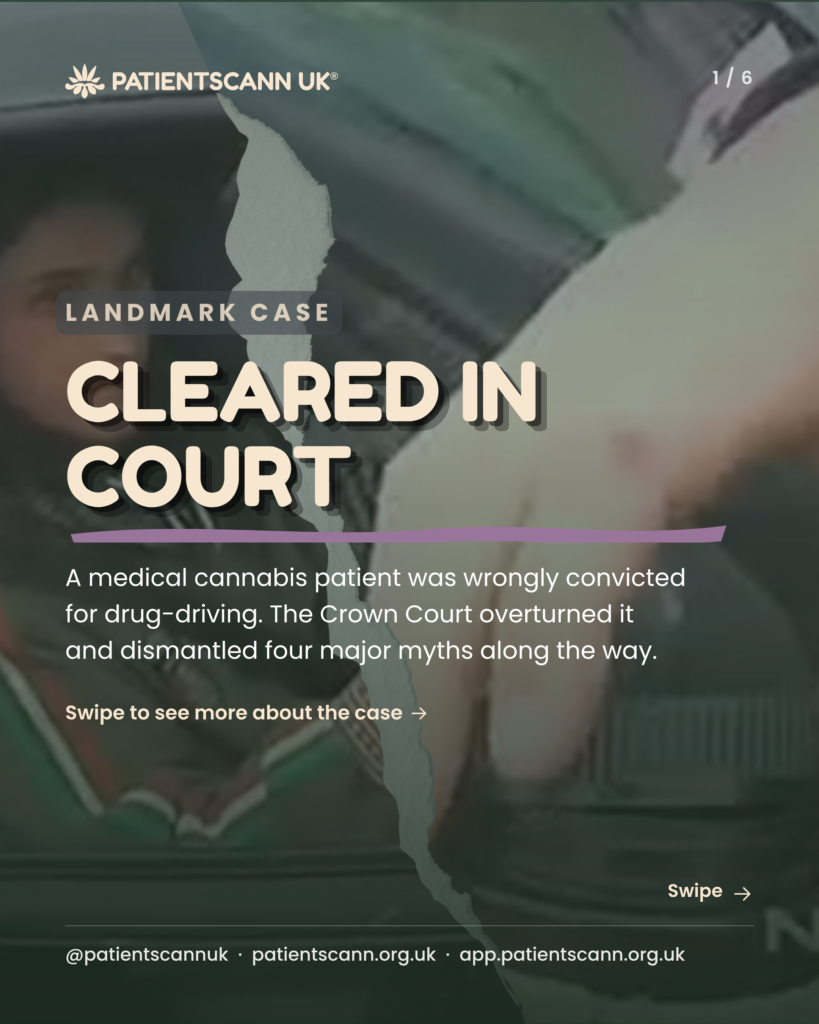
Cleared in court: a medical cannabis patient’s drug driving appeal | PatientsCann UK Skip to content Case study R v Saleem Aziz Acquitted Cleared in court: a medical cannabis patient’s drug driving appeal Sal Aziz was stopped by police, charged, and convicted. Then the Crown Court overturned it. Here is what happened, what the law really says, and what it means for patients, police, lawyers, and the courts. PatientsCann UK Drug driving and the medical defence Winchester Crown Court, 10 February 2026 Read the full report (PDF) On this page The story What happened The law Four myths Medical and science The evidence Why it was won What is broken Guidance Case files References This is not legal or medical advice This is a personal account and a public resource, based on real case papers, public reports, and the author’s understanding of the law. If you face a drug driving charge, get advice from a qualified solicitor and your medical team where you can. This case is a strong example, but every case turns on its own facts and evidence. The case at a glance Blood THC 3.6 micrograms per litre of blood, over the 2 microgram limit. Charges Two, under sections 4 and 5A of the Road Traffic Act 1988. Hearings Three court hearings before the right result was reached. Outcome Cleared. The conviction was overturned at the Crown Court. Overview The story in short Sal Aziz is a patient who is legally prescribed medical cannabis. In March 2024, police stopped the car he was driving as friends were being taken home from an event. He passed the roadside alcohol test. He told the officer straight away that he was a prescribed patient. A roadside drug swab showed cannabis, and he was asked to do a set of roadside tasks called a Field Impairment Test. He was arrested. A blood test later showed 3.6 micrograms of THC per litre of blood. The legal limit is 2 micrograms per litre. He was charged under two parts of the Road Traffic Act 1988: section 4 (driving while unfit) and section 5A (driving over the drug limit). The magistrates’ court dropped the section 4 charge but found him guilty of the section 5A offence. He was fined and banned from driving for 36 months. He appealed. On 10 February 2026, at Winchester Crown Court, Sal Aziz was cleared. The prosecution could not prove, beyond reasonable doubt, that his medical defence did not apply. The prosecution had argued his medicine was unlawful because more than 30 days had passed since the prescription, and because it was past its labelled use-by date. The court rejected this. The pharmacist expert, Umesh Chauhan, agreed that the “30 days” idea is best-practice guidance, not criminal law. The judge compared it to drinking milk after its best-before date. Passing the date does not make it unlawful to use. Crown Court reasoning, as described in the report Step by step What happened 1 About seven months before the stop A separate police encounter about his prescribed cannabis caused him serious distress. NHS notes record shaking, anxiety, and a hospital visit. Police contact was a known trigger for his physical symptoms. 2 31 March 2024: the stop On the A303, his car was stopped as part of an operation on vehicles leaving an event. There was no crash and no problem with his driving. The officer noted that he seemed nervous and shaky. 3 The roadside tests The alcohol breath test was negative. The roadside drug swab showed cannabis. He told the officer at once that he was a prescribed patient. He was then asked to do the Field Impairment Test: an eye check, a balance test, walking in a line, and touching his nose. 4 The arrest The officer treated the shaking and balance problems as signs of drug impairment. But these are also listed in his medical notes as symptoms of anxiety. He was arrested and his prescribed cannabis, in its labelled packet, was found. No proper interview about his condition took place. He was released to wait for blood results. 5 The blood result The blood test showed 3.6 micrograms of THC per litre of blood. This was over the 2 microgram limit. Nothing else was found. 6 The magistrates’ court The section 4 (unfit) charge was dropped. He was convicted of the section 5A (over the limit) charge. The court wrongly accepted that the medical defence did not apply because the medicine was “expired” or used beyond 28 to 30 days. He was fined and banned from driving for 36 months. 7 The appeal He appealed to the Crown Court, arguing that the medical defence applied. He brought prescription records, NHS notes, expert pharmacist evidence, and the science on THC. 8 10 February 2026: the result The appeal was allowed. The conviction was overturned. The prosecution had not disproved the medical defence. Plain English The law, in plain words Two parts of the Road Traffic Act 1988 matter here. They ask different questions, and it helps to keep them apart. Section 5A: over the drug limit It is an offence to drive with a named drug above a set limit in your blood. For cannabis, the limit is 2 micrograms of THC per litre of blood. This is a strict offence: the prosecution does not have to prove your driving was actually affected. The limit is set by the Drug Driving (Specified Limits) (England and Wales) Regulations 2014. Section 4: unfit through drugs This is a different offence. Here the prosecution must prove that your driving was actually impaired, and that a drug caused that impairment. This usually rests on observations, the Field Impairment Test, and expert evidence. The medical defence (section 5A(3)) If you are a lawful patient, you have a defence to the section 5A offence. You need to show three things. 1 It was prescribed or supplied for a medical reason For a medical or dental purpose. Self-medication or illegal use does
Care Before Discrimination
PatientsCann UK | Patient coalition appeal over plans to restrict CBD Press release Patient rights Patient groups across Europe launch an appeal over plans to restrict CBD A group of patient organisations, including PatientsCann UK®, has launched a public appeal and petition. They are worried about plans in the Czech Republic to treat CBD as if it were a chemical used to make illegal drugs. Their message is short: share the evidence, talk to the patients affected, and decide in the open. Sign the appeal PatientsCann UK® Coalition press release Prague, 17 June 2026 On this page In short Why it matters What we are asking Sign the appeal About the coalition References PatientsCann UK® is one of eight patient organisations in this coalition. The coalition campaigns on health policy and patient rights. It does not sell, promote, or link to any CBD product. In short What is happening Patient groups across Europe and beyond have launched a public appeal and petition called Care Before Discrimination is a Human Right. The worry Czech officials may treat CBD as a drug precursor, a chemical used to make illegal drugs, and limit how it can be handled. Not a ban on rules The coalition backs safety testing, honest labels, age limits, and real action against dangerous products. The ask Share the evidence, talk to the patients affected, and decide openly. You can add your name to the appeal. The background Why it matters CBD (cannabidiol) is a substance from the cannabis plant. It does not make a person feel high. On its own, it is not controlled under the main international drug laws. A purified CBD medicine is already approved across the European Union to treat severe forms of epilepsy, a condition that causes seizures. Because of this, the coalition says a sweeping restriction needs strong evidence behind it. It points to the International Narcotics Control Board, the United Nations body that watches drug controls. By that board’s own account, the proof that CBD is used to make illegal lab-made cannabinoids is limited. There is also a practical worry. The products that are truly risky are synthetic and semi-synthetic cannabinoids, which are part or fully man-made cannabis-like chemicals, often sold through grey-market channels. These need direct enforcement, age limits, and quality rules. The appeal is published just hours before the Czech Government’s Council for Addiction Policy meets on the afternoon of 17 June 2026. The unintended risk. If safe, tested CBD is pushed out of legal shops, demand will not disappear. It will move to an unregulated market, where contamination with heavy metals, pesticides, and solvents is far harder to catch. Patients aren’t asking for a loophole. We’re asking not to be pushed into the shadows. If the Government believes CBD should be restricted, show the evidence, listen to the patients it affects, and explain why the rules we already have aren’t enough. Care before discrimination means deciding in daylight. Pavel Kubů, KOPAC (Patient Association for Cannabis Treatment), Czech Republic What the coalition supports Clear quality standards. Testing for harmful substances. Honest labelling. Age limits. Real enforcement against dangerous synthetic products. What it is not asking for This is not a campaign against regulation, and it is not a request for a loophole. What the coalition objects to is a quiet, paperwork-only shortcut that rests on evidence no one has published. The appeal What we are asking The appeal calls on the Czech Government, European Union institutions, and United Nations drug-control bodies to: 1 Publish the evidence Share the proof before any CBD restriction is brought in. 2 No quiet shortcuts Avoid hidden or paperwork-only measures that skip public scrutiny. 3 Respect patient choice Respect patients’ freedom, dignity, and right to make informed decisions. 4 Regulate, do not ban Set fair and measured rules rather than a blanket prohibition. 5 Target the real risk Aim enforcement at dangerous synthetic and semi-synthetic products. 6 Consult patients first Talk to patient organisations before decisions are made. Add your name to the appeal The petition is open now. The full appeal, the evidence behind it, and the press kit are on the campaign site. The appeal is published in six languages. Sign the appeal Read the full appeal Who we are About the coalition Care Before Discrimination is a Human Right is an open coalition of patient organisations, with more joining. It campaigns on health policy and patient rights, and it does not promote, sell, or link to any CBD product. The appeal’s full title is “Care Before Discrimination: Patients’ Rights and the Proposed Restriction of CBD”. Aube Canada Centrum Paraple Czech Republic Dosemociones Spain Fuck Cancer Czech Republic HARP, Human Application Research Program Czech Republic KOPAC Czech Republic PatientsCann UK® United Kingdom Verein Medcan Switzerland Coalition media contact media@cbdhumanright.org Spokespeople are available in English, Czech, Spanish, French, German, and Italian. The team replies within a working day, and faster around procedural deadlines. PatientsCann UK® press press@patientscann.org.uk For media enquiries about PatientsCann UK® and our part in the coalition. Note The appeal is available in six languages (English, Czech, Spanish, French, German, and Italian) on the campaign site and in the downloadable press kit. In the Kanavape case, the European Union’s top court held that a member state may not ban the sale of CBD lawfully produced in another member state unless a restriction is necessary and proportionate, meaning fair and no more than is needed. The CBD in that case was produced in the Czech Republic. HHC, a semi-synthetic cannabinoid, was added to Schedule II of the 1971 Convention on Psychotropic Substances by the United Nations Commission on Narcotic Drugs. The decision took effect on 6 December 2025. The primary sources behind the appeal are listed in full below. References References follow the Harvard style. Sources with no named author are listed by the responsible body. All links were checked on 17 June 2026. 1World Health Organization (2018) Cannabidiol (CBD): critical review report. Expert Committee on Drug Dependence, fortieth meeting, Geneva, 4 to
