Linalool
Linalool – PatientsCann UK Skip to main content Back to Terpenes Guide Linalool Linalool alcohol pronounced: lin-AL-oh-ol The calming lavender terpene. Found in over 200 plant species. Monoterpene Boiling point: 198°C Terpene type Monoterpene Boiling point 198°C Primary aroma Floral Key effect Calm Aroma profile How it Smells The aroma of linalool is described as: FloralLavenderSweet HerbSage Found naturally in: Lavender, mint, coriander, rosewood, jasmine Effects Linked Effects CalmSleep supportRelaxingAnti-anxiety These effects are based on early-stage research in animals and cells. They are not proven in humans. Do not change your treatment based on this information. About What is Linalool? Linalool is the terpene responsible for lavender’s famous calming scent. It is one of the most widely distributed terpenes in nature, appearing in over 200 different plants including mint, coriander, and many trees. When a cannabis strain has a soft, floral, slightly soapy smell, linalool is usually the reason. Unlike some terpenes that are present only in small amounts, linalool can be a major component in certain cannabis strains. It is a monoterpene alcohol, which gives it a slightly heavier, more complex character than simpler terpenes like limonene (Booth and Bohlmann, 2019). Effects in detail What the Research Says Linalool has one of the strongest bodies of evidence among cannabis terpenes for calming and sleep-supporting effects. Weston-Green et al. (2021) reviewed studies showing that inhaled linalool can reduce anxiety-like behaviour in animals, and that it appears to enhance the activity of GABA, a brain chemical that promotes relaxation and sleep. Abstrax Tech (2023) conducted studies with Western Washington University finding that a combination of linalool and myrcene produced notable anxiolytic (anti-anxiety) effects. Baram et al. (2022) confirmed that linalool activates CB1 and CB2 receptors, adding to its known mechanisms of action. Everyday sources Where You Find it in Daily Life Lavender is the most obvious everyday source. Lavender oil, widely sold in pharmacies and health shops, is mostly linalool. It is the active ingredient that makes lavender pillows and sleep sprays effective for some people. Coriander seeds contain high amounts too, which contributes to their floral, slightly soapy flavour. Linalool is one of the most commonly used fragrance ingredients in the world. It is found in many shampoos, soaps, and cosmetics, as well as in some foods as a natural flavouring. It is generally considered safe at typical exposure levels. Research Key Studies Weston-Green et al. (2021) specifically reviewed linalool alongside alpha-pinene as a potential medicine for brain health. They found preclinical evidence for anti-anxiety, antidepressant, anticonvulsant, and neuroprotective effects. The authors noted that the evidence base is growing but human clinical trials are still limited. Abstrax Tech (2023) reported collaborative research demonstrating anxiolytic synergy between linalool and myrcene, suggesting that terpene combinations may be more powerful than individual compounds. This supports the broader entourage effect framework described by Russo (2011). Previous Camphene Next Beta-Caryophyllene Back to full Terpenes Guide Important: The information on this page is for education only. It is not medical advice. Terpene research is still in its early stages. Many studies have been done in animals, not yet in people. Always speak to your doctor before changing your treatment. PatientsCann UK does not recommend any specific cannabis product. References Abstrax Tech (2023) Linalool and beta-myrcene anxiolytic study with Western Washington University. Available at: https://abstraxtech.com/pages/terpene-research (Accessed: 29 May 2026). Baram, L. et al. (2022) ‘Major cannabis terpenes, applied individually and in combination, activate endogenous cannabinoid CB1 and CB2 receptors’, Frontiers in Pharmacology, 13, 1040962. doi: 10.3389/fphar.2022.1040962. Booth, J.K. and Bohlmann, J. (2019) ‘Terpenes in Cannabis sativa: from plant genome to humans’, Plant Science, 284, pp. 67-72. doi: 10.1016/j.plantsci.2019.03.022. Russo, E.B. (2011) ‘Taming THC: potential cannabis synergy and phytocannabinoid-terpenoid entourage effects’, British Journal of Pharmacology, 163(7), pp. 1344-1364. doi: 10.1111/j.1476-5381.2011.01238.x. Weston-Green, K. et al. (2021) ‘A review of the potential use of pinene and linalool as terpene-based medicines for brain health’, Frontiers in Psychiatry, 12, 583211. doi: 10.3389/fpsyt.2021.583211.
Beta-Caryophyllene
Beta-Caryophyllene – PatientsCann UK Skip to main content Back to Terpenes Guide Beta-Caryophyllene β-Caryophyllene (BCP) pronounced: BAY-tuh kair-ee-oh-FIL-een The only terpene that acts like a cannabinoid. Activates CB2 receptors directly. Sesquiterpene Boiling point: 130°C Terpene type Sesquiterpene Boiling point 130°C Primary aroma Spicy Key effect Pain relief Aroma profile How it Smells The aroma of beta-caryophyllene is described as: SpicyPepperyWoodyWarm Clove Found naturally in: Black pepper, cloves, cinnamon, oregano, copaiba Effects Linked Effects Pain reliefAnti-inflammatoryCalmNeuroprotective These effects are based on early-stage research in animals and cells. They are not proven in humans. Do not change your treatment based on this information. About What is Beta-Caryophyllene? Beta-caryophyllene is unique among terpenes. While most terpenes add to the cannabis experience through aroma and indirect effects, beta-caryophyllene can directly activate a receptor in the body called CB2. This is the same type of receptor that CBD works on. Because of this, some scientists classify it as a dietary cannabinoid as well as a terpene (Hashiesh et al., 2021). It is a sesquiterpene, meaning it is a larger molecule than monoterpenes like myrcene or limonene. This makes it less volatile and it tends to linger in the smell of a strain longer. Its aroma is immediately recognisable: the sharp, spicy heat of freshly ground black pepper (Booth and Bohlmann, 2019). Effects in detail What the Research Says Because beta-caryophyllene binds to CB2 receptors, it can influence inflammation and immune responses. CB2 receptors are found mainly outside the brain, particularly in immune cells, which means BCP can affect inflammation without causing psychoactive effects (Hashiesh et al., 2021). Preclinical studies have found potential benefits for pain relief, anxiety reduction, and even neuroprotection. Russo (2011) identified it as one of the most clinically interesting terpenes precisely because of its direct receptor activity. Research is ongoing into its potential for conditions involving chronic pain and inflammation. Everyday sources Where You Find it in Daily Life Black pepper is the richest everyday source. When you smell a pepper grinder, the spicy, slightly woody warmth is beta-caryophyllene. Cloves and cinnamon also contain high amounts, and it is a significant component of oregano, basil, and rosemary. Copaiba oil, used in traditional Amazonian medicine and now sold as a wellness supplement, contains very high concentrations of beta-caryophyllene. Some researchers studying copaiba’s anti-inflammatory properties believe BCP is the active ingredient responsible for its effects. Research Key Studies The landmark paper that established beta-caryophyllene as a CB2 agonist was published by Gertsch et al. (2008), though it is cited through Hashiesh et al. (2021) in this guide’s scope. Hashiesh and colleagues reviewed the broad pharmacological evidence and concluded that BCP has significant therapeutic potential for inflammatory and neuropathic conditions. Baram et al. (2022) confirmed that BCP activates CB2 at concentrations found in cannabis products, strengthening the case for its clinical relevance. Its non-psychoactive nature makes it particularly interesting as a potential therapeutic target. Previous Linalool Next γ-Elemene Back to full Terpenes Guide Important: The information on this page is for education only. It is not medical advice. Terpene research is still in its early stages. Many studies have been done in animals, not yet in people. Always speak to your doctor before changing your treatment. PatientsCann UK does not recommend any specific cannabis product. References Baram, L. et al. (2022) ‘Major cannabis terpenes, applied individually and in combination, activate endogenous cannabinoid CB1 and CB2 receptors’, Frontiers in Pharmacology, 13, 1040962. doi: 10.3389/fphar.2022.1040962. Booth, J.K. and Bohlmann, J. (2019) ‘Terpenes in Cannabis sativa: from plant genome to humans’, Plant Science, 284, pp. 67-72. doi: 10.1016/j.plantsci.2019.03.022. Hashiesh, H.S. et al. (2021) ‘A focused review on CB2 receptor-selective pharmacological properties and therapeutic potential of beta-caryophyllene’, Biomedicine and Pharmacotherapy, 140, 111639. doi: 10.1016/j.biopha.2021.111639. Russo, E.B. (2011) ‘Taming THC: potential cannabis synergy and phytocannabinoid-terpenoid entourage effects’, British Journal of Pharmacology, 163(7), pp. 1344-1364. doi: 10.1111/j.1476-5381.2011.01238.x.
Alpha-Pinene
Alpha-Pinene – PatientsCann UK Skip to main content Back to Terpenes Guide Alpha-Pinene α-Pinene pronounced: AL-fuh PY-neen Smells like a pine forest. Found in pine needles and rosemary. Monoterpene Boiling point: 156°C Terpene type Monoterpene Boiling point 156°C Primary aroma Pine Key effect Focus Aroma profile How it Smells The aroma of alpha-pinene is described as: PineResinousSharp WoodFresh Forest Found naturally in: Pine needles, rosemary, basil, dill, eucalyptus Effects Linked Effects FocusEnergyAnti-inflammatoryMemory support These effects are based on early-stage research in animals and cells. They are not proven in humans. Do not change your treatment based on this information. About What is Alpha-Pinene? Alpha-pinene is the most abundant terpene in the natural world. If you have ever walked through a pine forest and taken a deep breath, you have experienced it directly. It gives pine trees their sharp, clean, resinous smell and is the dominant scent in rosemary and eucalyptus. In cannabis, alpha-pinene is one of the secondary terpenes found in many strains. It contributes a piney, fresh edge to the overall aroma. Strains high in pinene are sometimes described as smelling like a forest floor or fresh herbs (Booth and Bohlmann, 2019). Effects in detail What the Research Says Alpha-pinene is one of the most studied terpenes for its effects on the mind. It is a known bronchodilator at low concentrations, meaning it can help open up the airways. Weston-Green et al. (2021) reviewed evidence suggesting pinene may support memory and alertness by blocking enzymes that break down acetylcholine, a brain chemical involved in memory and attention. This is particularly interesting in the context of medical cannabis, because some people report that high-THC products can affect memory temporarily. The presence of alpha-pinene in a strain may partially counteract this effect (Russo, 2011). It also has well-documented anti-inflammatory properties. Everyday sources Where You Find it in Daily Life Rosemary is probably the easiest everyday source of alpha-pinene. When you rub a sprig of rosemary between your fingers, the sharp, piney smell you get is largely alpha-pinene. Basil, dill, and parsley also contain it, as do many coniferous trees. Pine-scented cleaning products and air fresheners almost always use pinene as the fragrance source. It is considered safe at normal exposure levels and is approved as a food flavouring in many countries. Research Key Studies Weston-Green et al. (2021) published a detailed review of the potential of pinene as a medicine for brain health. They found evidence from preclinical studies that it can reduce anxiety, improve memory, and act as a neuroprotective compound, though human clinical trials are still limited. Russo (2011) highlighted alpha-pinene specifically as a terpene that may modulate the psychoactive effects of THC by inhibiting acetylcholinesterase, helping to maintain working memory. Nuutinen (2018) confirmed these findings across a broader review of cannabis terpene pharmacology. Previous α-Terpinene Next β-Pinene Back to full Terpenes Guide Important: The information on this page is for education only. It is not medical advice. Terpene research is still in its early stages. Many studies have been done in animals, not yet in people. Always speak to your doctor before changing your treatment. PatientsCann UK does not recommend any specific cannabis product. References Booth, J.K. and Bohlmann, J. (2019) ‘Terpenes in Cannabis sativa: from plant genome to humans’, Plant Science, 284, pp. 67-72. doi: 10.1016/j.plantsci.2019.03.022. Nuutinen, T. (2018) ‘Medicinal properties of terpenes found in Cannabis sativa and Humulus lupulus’, European Journal of Medicinal Chemistry, 157, pp. 198-228. doi: 10.1016/j.ejmech.2018.07.076. Russo, E.B. (2011) ‘Taming THC: potential cannabis synergy and phytocannabinoid-terpenoid entourage effects’, British Journal of Pharmacology, 163(7), pp. 1344-1364. doi: 10.1111/j.1476-5381.2011.01238.x. Weston-Green, K. et al. (2021) ‘A review of the potential use of pinene and linalool as terpene-based medicines for brain health’, Frontiers in Psychiatry, 12, 583211. doi: 10.3389/fpsyt.2021.583211.
Limonene
Limonene – PatientsCann UK Skip to main content Back to Terpenes Guide Limonene D-Limonene pronounced: LIM-oh-neen The bright, citrus terpene. Found in lemon peel and orange rind. Monoterpene Boiling point: 177°C Terpene type Monoterpene Boiling point 177°C Primary aroma Citrus Key effect Uplifting Aroma profile How it Smells The aroma of limonene is described as: CitrusTangyLemonOrangeZesty Sour Found naturally in: Lemon and orange peel, peppermint, rosemary, juniper Effects Linked Effects UpliftingCalmStress reliefFocus These effects are based on early-stage research in animals and cells. They are not proven in humans. Do not change your treatment based on this information. About What is Limonene? Limonene is the terpene responsible for that sharp, clean citrus smell. It is one of the most widely found terpenes in nature and is the main compound that gives lemon and orange peel their unmistakable scent. In cannabis, strains high in limonene often smell like a fresh citrus fruit or lemon sherbet. As a monoterpene, limonene is a relatively simple molecule that is highly volatile, meaning it evaporates quickly. This is why cutting a lemon releases that burst of smell almost immediately. In cannabis, limonene is often most noticeable in the first wave of aroma when a jar is opened (Booth and Bohlmann, 2019). Effects in detail What the Research Says Limonene is strongly associated with mood-lifting and stress-reducing effects. Laboratory studies have found it can reduce anxiety-like behaviour in animals (Nuutinen, 2018). Several clinical and preclinical studies suggest it may act on serotonin and dopamine pathways in the brain, which are linked to mood regulation. Research by Baram et al. (2022) found that limonene, like myrcene, can activate CB2 receptors. This means it is not merely adding aroma: it may interact with the body’s endocannabinoid system directly. Some studies also report anti-inflammatory and antioxidant properties at higher concentrations. Everyday sources Where You Find it in Daily Life Limonene is everywhere in the kitchen. The white pith and coloured skin of any citrus fruit contain high concentrations of it. Lemon-flavoured cleaning products almost always use limonene as the active fragrance ingredient, and it is approved as a food flavouring across the UK and EU. You will also find limonene in rosemary, juniper berries, and peppermint. It is used extensively in the fragrance industry and is one of the most commonly added flavours in food and drinks. Research Key Studies A key study by Russo (2011) highlighted limonene as a terpene with notable anti-anxiety and antidepressant potential based on animal and in vitro research. He proposed that the entourage effect partly relies on limonene interacting with serotonin receptors. Baram et al. (2022) later confirmed that limonene can activate endocannabinoid receptors at physiologically relevant concentrations. This was a significant finding because it moved limonene from a simple aromatic compound to a potentially pharmacologically active molecule in its own right. Previous Valencene Next Δ-3-Carene Back to full Terpenes Guide Important: The information on this page is for education only. It is not medical advice. Terpene research is still in its early stages. Many studies have been done in animals, not yet in people. Always speak to your doctor before changing your treatment. PatientsCann UK does not recommend any specific cannabis product. References Baram, L. et al. (2022) ‘Major cannabis terpenes, applied individually and in combination, activate endogenous cannabinoid CB1 and CB2 receptors’, Frontiers in Pharmacology, 13, 1040962. doi: 10.3389/fphar.2022.1040962. Booth, J.K. and Bohlmann, J. (2019) ‘Terpenes in Cannabis sativa: from plant genome to humans’, Plant Science, 284, pp. 67-72. doi: 10.1016/j.plantsci.2019.03.022. Nuutinen, T. (2018) ‘Medicinal properties of terpenes found in Cannabis sativa and Humulus lupulus’, European Journal of Medicinal Chemistry, 157, pp. 198-228. doi: 10.1016/j.ejmech.2018.07.076. Russo, E.B. (2011) ‘Taming THC: potential cannabis synergy and phytocannabinoid-terpenoid entourage effects’, British Journal of Pharmacology, 163(7), pp. 1344-1364. doi: 10.1111/j.1476-5381.2011.01238.x.
Ocimene
Ocimene – PatientsCann UK Skip to main content Back to Terpenes Guide Ocimene Beta-Ocimene, cis/trans-Ocimene pronounced: OH-sih-meen Sweet, tropical, and herbaceous. The lowest boiling point of the main terpenes. Monoterpene Boiling point: 50°C Terpene type Monoterpene Boiling point 50°C Primary aroma Sweet Key effect Uplifting Aroma profile How it Smells The aroma of ocimene is described as: SweetHerbaceousPerfumedCitrusTropical Found naturally in: Mint, parsley, orchids, mangoes, tarragon, basil Effects Linked Effects UpliftingEnergyAntiviralAntifungal These effects are based on early-stage research in animals and cells. They are not proven in humans. Do not change your treatment based on this information. About What is Ocimene? Ocimene is a sweet, tropical terpene with a complex aroma that blends fresh herbs, citrus blossom, and a hint of fruit. Cannabis plants produce it partly as a natural defence against insects and pests. When a strain has a fresh, almost perfume-like quality to its smell, ocimene is often a significant contributor. It has the lowest boiling point of the main cannabis terpenes at around 50 degrees Celsius. This means it evaporates very quickly. Fresh or recently cured cannabis will have more ocimene aroma than older or poorly stored cannabis, where it will have largely evaporated. This is why it is most noticeable in very fresh flower (Booth and Bohlmann, 2019). Effects in detail What the Research Says Ocimene is associated with uplifting and energising effects, similar to limonene and terpinolene. It does not have as extensive a human evidence base as some other terpenes, but preclinical research has found antiviral, antifungal, and anti-inflammatory properties (Nuutinen, 2018). Its antiviral properties are of particular scientific interest. Studies have found that ocimene can inhibit the activity of certain viruses in cell cultures, though this is laboratory research and does not mean it treats viral infections in humans. LaVigne et al. (2021) found that it can modulate cannabinoid receptor activity, contributing to the entourage effect. Everyday sources Where You Find it in Daily Life Mint is one of the richer everyday sources of ocimene. The fresh, slightly sweet quality of mint that is distinct from its menthol sharpness comes partly from ocimene. Parsley, basil, and tarragon also contain it. Orchid flowers produce significant amounts of ocimene as a pollinator attractant. Mangoes contain a small but noticeable quantity, adding to their complex tropical aroma. Because it evaporates so easily, the best way to experience ocimene in everyday food is to eat fresh, uncooked herbs. Research Key Studies Nuutinen (2018) reviewed evidence for ocimene’s antifungal and anticonvulsant activity in preclinical models. The antifungal properties are consistent across several studies and suggest potential clinical applications for fungal skin conditions, though human trials are lacking. Weil (2022) notes that ocimene’s presence in a strain profile is often a marker for fresh, recently harvested cannabis because of its volatility. LaVigne et al. (2021) confirmed that ocimene participates in cannabinoid receptor modulation alongside other cannabis terpenes, providing another mechanism through which it may contribute to the overall experience of a strain. Previous α-Phellandrene Next Geranyl-Acetate Back to full Terpenes Guide Important: The information on this page is for education only. It is not medical advice. Terpene research is still in its early stages. Many studies have been done in animals, not yet in people. Always speak to your doctor before changing your treatment. PatientsCann UK does not recommend any specific cannabis product. References Booth, J.K. and Bohlmann, J. (2019) ‘Terpenes in Cannabis sativa: from plant genome to humans’, Plant Science, 284, pp. 67-72. doi: 10.1016/j.plantsci.2019.03.022. LaVigne, J.E. et al. (2021) ‘Cannabis sativa terpenes are cannabimimetic and selectively enhance cannabinoid activity’, Scientific Reports, 11(1), 8232. doi: 10.1038/s41598-021-87740-8. Nuutinen, T. (2018) ‘Medicinal properties of terpenes found in Cannabis sativa and Humulus lupulus’, European Journal of Medicinal Chemistry, 157, pp. 198-228. doi: 10.1016/j.ejmech.2018.07.076. Weil, M. (2022) ‘Most common cannabis terpenes and what they do’, Cannigma. Available at: https://cannigma.com/plant/a-brief-history-of-terpenes/ (Accessed: 29 May 2026).
Myrcene
The most common terpene in cannabis. Found in mangoes and hops.
UK-First Inpatient Medical Cannabis Policy

Devon Partnership NHS Trust has formally approved CD21, a Standard Operating Procedure that gives medical cannabis patients a clear, safe pathway to continue their lawful prescriptions while admitted to hospital. Here is what it means for you.
Bedrocan May 2026 Press Release
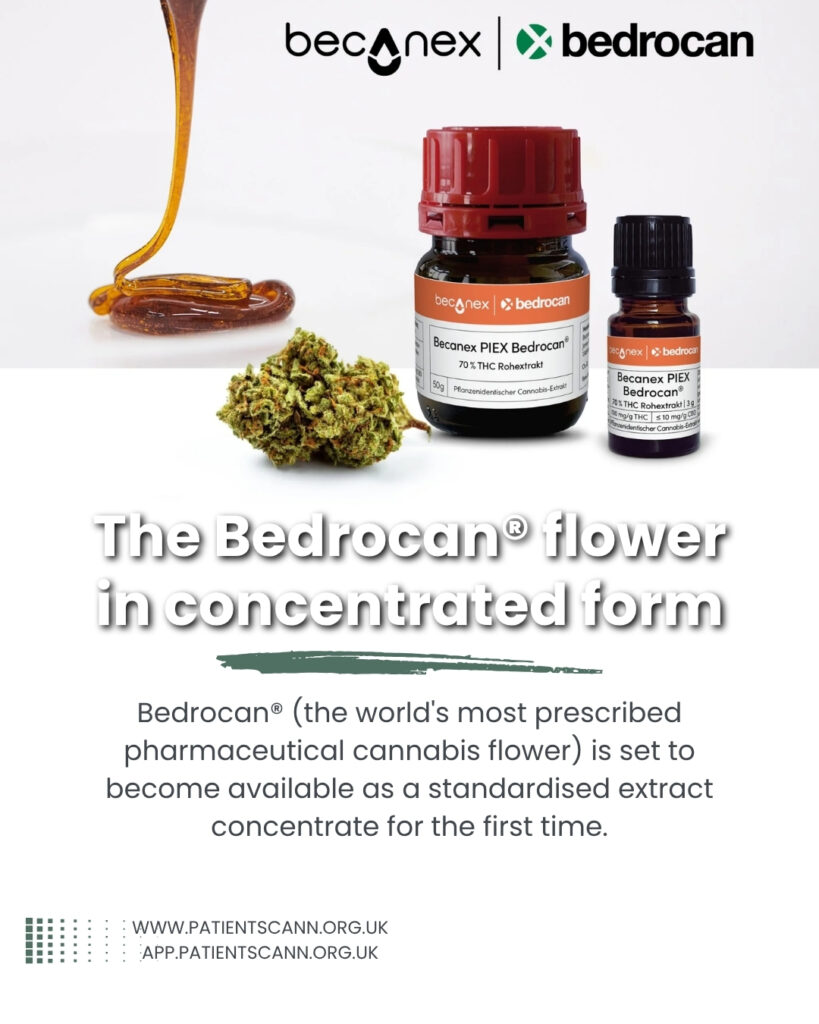
New Bedrocan® Concentrate Opens Up More Ways to Take Your Prescription – PatientsCann UK Skip to main content Industry News · Prescribing Options A trusted flower,now in a new form Bedrocan® — the world’s most prescribed pharmaceutical cannabis flower — is set to become available as a standardised extract concentrate for the first time. For patients, that could mean the same trusted medicine available in more ways than ever before. PatientsCann UK · Industry News · 19 May 2026 Jump to: What Is It? Formulations Why It Matters Timeline 20+ years of Bedrocan® pharmaceutical cannabis production trusted by doctors worldwide 70% THC concentration in the new Becanex PIEX Bedrocan® extract — preserving the full cannabinoid and terpene fingerprint 5+ preparation formats now possible from a single standardised concentrate, from capsules to inhalation 2026 Target launch date for pharmacy ordering across Europe, with Germany as the first market What Is It? The Bedrocan® flower you know — in concentrated form If you have been prescribed Bedrocan® flower, you will know it as one of the most consistent and well-studied pharmaceutical cannabis products available. Grown in EU-GMP-certified facilities in the Netherlands and Denmark by Bedrocan International, it has been the benchmark for standardised medical cannabis for more than two decades. Now, that same product is set to take a new form. Berlin-based extraction specialist Becanex GmbH has developed the Becanex PIEX Bedrocan® 70% THC Concentrate — an extract that, for the first time, brings the full cannabinoid and terpene fingerprint of the Bedrocan® flower into a standardised, pharmacist-ready concentrate. The extract is produced using Becanex’s proprietary PIEX (Plant-Identical Extraction) process, which is specifically designed to preserve what makes a particular cannabis strain therapeutically distinctive. In simpler terms: this is not a generic cannabis extract. It is Bedrocan® in a bottle — the same profile, in a versatile new format. What makes it different from other extracts? Many cannabis extracts are produced to isolate one or two cannabinoids — often just THC or CBD — and discard the rest. The PIEX method takes a different approach, retaining the full spectrum of naturally occurring cannabinoids and terpenes in proportions that match the original flower. Becanex describes this as “a fingerprint” of the source material, and that precision matters clinically: the interaction between cannabinoids and terpenes — sometimes called the entourage effect — is increasingly recognised as relevant to therapeutic outcomes. The result is a concentrate that is both highly potent (at 70% THC) and pharmacologically familiar to doctors and pharmacists who have already been prescribing Bedrocan® flower. “We have always been precise about how we grow our cannabis. Becanex is equally precise about how they extract it. That shared attention to detail is what makes this product worth putting in front of pharmacists, prescribers and patients. The concentrate now enables doctors to prescribe our main product Bedrocan® in multiple compounding formulations.” Jaap Erkelens — CEO, Bedrocan International Formulations More ways for pharmacists to prepare your medicine One of the most significant implications of this product for patients is flexibility. A standardised concentrate that sits in a pharmacy’s dispensary can be compounded into a wide range of preparation formats, tailored to what works best for each individual. The Becanex PIEX Bedrocan® concentrate is specifically designed for the following preparations: Oral solution Capsules Suppositories Topical forms Inhalation dosage Vaporisation What this means in practice for patients For patients currently prescribed Bedrocan® flower, this is particularly significant. If inhalation becomes difficult — whether due to respiratory concerns, lifestyle factors, or simply personal preference — a concentrated extract from the same strain could potentially be offered as an oral or capsule-based alternative, without switching to an entirely different product. The vaporisation option is also noteworthy: the concentrate can be vaporised directly, giving patients an additional inhalation route alongside the flower. This kind of flexibility within a single, consistent product profile is exactly the kind of development that helps both patients and prescribers make evidence-informed adjustments over time. It is important to note that any change to your prescription formulation must always be discussed with and authorised by your prescribing specialist. The availability of a new format does not mean your prescription changes automatically — it expands the options your clinician can consider for you. “Patients who have found a cannabis strain that works well for them shouldn’t have to compromise if they need it in a different form. With Bedrocan as our partner, we can now offer prescribers exactly that — building on a strain they already know and trust.” Sebastian Kamphorst — Director, Becanex GmbH Why It Matters Why standardisation matters for patients Consistency you can rely on One of the greatest frustrations for patients on prescribed cannabis is variability. A standardised extract — manufactured under GMP conditions from a named, controlled cultivar — reduces that uncertainty. You and your prescriber know what to expect. No need to start from scratch For patients and doctors who have already found that Bedrocan® works, this product preserves that relationship. Switching formulation format does not mean re-establishing which strain or cannabinoid profile is therapeutically appropriate. Pharmacist flexibility Compounding pharmacies are central to how many patients receive their prescribed cannabis. A concentrate designed specifically for compounding gives pharmacists more tools to prepare bespoke preparations that suit individual clinical needs. Germany first, Europe next Germany is the first market for the launch, which reflects its position as the most developed regulated medical cannabis market in Europe. UK patients should watch this development closely — it signals the direction of travel for product diversity across Europe. A decade in the making This collaboration is not simply a commercial arrangement — it has roots going back more than ten years. As early as 2014, the founding team behind Becanex worked with Bedrocan under a scientific licence to develop the first extracts from the Bedrocan® flower. At the time, the regulatory framework to bring such a product to market did not exist. Today, it does. Kamphorst reflects on this directly: the team is not
Prescription Direction in Medical Cannabis: Guidance for Clinicians and Patients
Prescription Direction in Medical Cannabis: Guidance for Clinicians and Patients – PatientsCann UK Skip to main content Education GMC Guidance Aligned CQC Standards Prescription Direction in Medical Cannabis:Guidance for Clinicians and Patients In the UK, most medical cannabis, legally termed cannabis-based medicinal products (CBPMs), is prescribed by specialists in the private sector. Issues around prescription direction, where patients are steered toward specific pharmacies or restricted product lists, have become critical ethical and professional considerations for the sector. PatientsCann UK · Education & Guidance · Published 23 March 2026 · ~6 min read GMC General Medical Council | Prescribing Standards Aligned with GMC guidance on cannabis-based products for medicinal use (2026) CQC Care Quality Commission Provider expectations for independent CBPM clinics Reviewed February 2026 Jump to Definition Legal Framework For Clinicians For Patients Summary References At a Glance Three principles that underpin this guidance Patient Owns the Prescription Once issued, a valid prescription belongs to the patient — not the clinic. Patients may take it to any appropriately registered pharmacy. Clinical Grounds Only Any direction toward a specific pharmacy or product must be clinically justified. Commercial or operational preferences are not sufficient grounds. Regulatory Accountability Independent CBPM clinics are regulated by the CQC. Professional conduct is subject to GMC oversight. Patients can raise concerns with either body. Definition What is “Prescription Direction”? Key Term ‘Prescription Direction’ refers to any practice in which a healthcare provider influences or obligates a patient to use a particular pharmacy or dispensing service, or restricts which products may be prescribed based on a clinic’s internal formulary rather than clinical considerations alone. For standard prescription-only medicines, and CBPMs alike, once a valid prescription is issued, the patient, not the issuing clinic or prescriber, owns the prescription and has the right to have it dispensed at any appropriate pharmacy. Professional guidance makes no provision for locking prescriptions to a particular dispensing outlet on non-clinical grounds. [1] This issue has grown in practical significance as the UK’s private medical cannabis sector has expanded. Patients, many managing chronic and complex conditions, must be able to access the most suitable products at pharmacies they can practically use and afford. Legal & Regulatory Framework Prescribing medical cannabis in the UK Who Can Prescribe GMC Specialist Register Only CBPMs (excluding those with a marketing authorisation like Sativex®) are predominantly unlicensed medicines. The law restricts their prescription to doctors on the GMC’s Specialist Register, acting within their area of competence. [3] Clinic Regulation Care Quality Commission Independent clinics prescribing CBPMs are regulated by the CQC, which requires clinical governance, prescriber competence, patient safety, informed consent, and compliance with controlled drugs legislation. [4] Pharmacy Supply Any Registered Pharmacy There is no single official UK “list” of pharmacies for CBPMs. Any pharmacy that is properly registered and complies with regulatory standards may dispense them once presented with a valid prescription. [5] Unlicensed Medicines and Clinical Responsibility Unlicensed medicines entail additional responsibilities for prescribers because they have not undergone the full range of regulatory assessments for safety, quality and efficacy. Prescribers must therefore be confident that the product is appropriate for the individual patient, and must explain to patients the unlicensed nature of the treatment as part of informed decision-making. [1][5] Shared Care Arrangements NHS England guidance confirms that while subsequent prescriptions may sometimes be made under shared care arrangements, initial prescriptions must be authorised by a specialist clinician. This reinforces the importance of maintaining robust clinical oversight throughout a patient’s CBPM treatment pathway. [2] Conflicts of Interest The CQC guidance confirms that providers must ensure prescribing decisions are clinically justified, appropriately documented, and made in the best interests of the patient, with systems in place to manage risk and avoid conflicts of interest. This includes ensuring that organisational or commercial arrangements do not compromise professional judgement or patient choice in prescribing or supply pathways. [4] For Clinicians Responsibilities for prescribing doctors Many private medical cannabis clinics operate internal formularies, lists of products they commonly prescribe based on clinician familiarity, supply arrangements, or existing protocols. There may be legitimate clinical reasons to prefer certain products (e.g. formulations with established pharmacological profiles or evidence bases). However, clinicians must never refuse to consider other products solely because they are not on an internal clinic list, without clinical reasoning. [1] Clinical judgement during prescribing must always focus on the patient’s individual needs rather than operational convenience or commercial preference. This is consistent with all prescribing guidance for individualised care. Do’s for Clinicians Respect patient choice of pharmacy — inform patients they may take their prescription to any appropriately registered pharmacy capable of dispensing CBPMs Provide balanced product information — discuss evidence, risks, benefits, and availability of relevant CBPMs to enable informed decision-making Explain formulary limits transparently — if prescribing experience is concentrated on certain products, clarify this and discuss why other products may be clinically appropriate Follow GMC prescribing standards — ensure decisions are based on clinical evidence and patient needs, not commercial relationships [1] Operate within CQC governance expectations — maintain transparency in prescribing practices and avoid commercial influence on clinical decision-making [4] Don’ts for Clinicians Do not require patients to use a particular pharmacy for non-clinical reasons Do not imply that prescriptions are “owned” by the clinic or that patients must dispense through a preferred partner Do not limit prescribing to products on an internal formulary if other products are clinically suitable and available Do not allow commercial arrangements with pharmacies or manufacturers to influence clinical prescribing choices Any practice that restricts patient choice on non-clinical grounds may undermine professional ethics and patient trust. For Patients Your rights as a CBPM patient Know Your Rights What you are entitled to You have the right to choose the pharmacy that dispenses your prescription, provided it is registered and authorised to supply controlled drugs and CBPMs [5] A prescription is your legal document, it may be taken to any suitable registered pharmacy Clinicians must explain the clinical basis for any recommended product, including risks and benefits, to support informed
THCa is it legal?
PatientsCann UK — THCa — Is It Legal? Education Cannabinoids February 2025 THCa — Is It Legal in the UK? Tetrahydrocannabinolic acid (THCa) is a non-psychoactive cannabinoid found in raw cannabis. This guide explains its biochemistry, therapeutic potential, and — critically — its legal status in the United Kingdom. PatientsCann UK·Education·6 February 2025 · Updated March 2026 What Is THCa? THCa is the acidic precursor to THC found naturally in raw cannabis plants. In its unheated form it is non-psychoactive — it does not produce a “high.” The Critical Caveat When heated (smoking, vaping, cooking), THCa undergoes decarboxylation and converts into THC — gaining psychoactive properties. This conversion is legally significant. Therapeutic Potential Emerging research suggests THCa may offer several health benefits in its raw form: Anti-inflammatory properties: may reduce inflammation relevant to arthritis and other inflammatory diseases Neuroprotective effects: may protect nerve cells, with applications in neurodegenerative disorders Antiemetic benefits: may alleviate nausea and vomiting for patients undergoing chemotherapy or with chronic gastrointestinal conditions Legal Status in the UK The ACMD has addressed THCa’s control status in its consumer CBD report. While THCa in its raw state does not produce psychoactive effects, its potential to convert to THC on heating means it sits in a legally complex position under UK law. Important: The legal status of THCa in the UK is not straightforwardly settled. Under the Misuse of Drugs Act 1971, cannabis and its cannabinoids are controlled. THCa products sold outside of a legitimate prescription pathway carry significant legal risk. PatientsCann UK recommends patients only access cannabinoids via licensed clinics and regulated prescribers. Educational Disclaimer This article is for educational purposes only. It is not legal advice. Laws change — always consult a qualified solicitor or your prescribing clinic for guidance specific to your situation. Mohammad Ismail “Ish” Wasway · Managing DirectorPatientsCann UK® · UK’s Medical Cannabis Patient Organisation · patientscann.co.uk
