Some Are More Equal Than Others…
Medical cannabis patients are often told that they are protected by the Equality Act 2010. For many patients, that may be true. But it is not true simply because somebody has been prescribed cannabis.
The legal test
A prescription is not a disability certificate
The Equality Act protects disability as a legal status. It does not create a separate protected characteristic of being a patient, taking prescribed medication or holding a medical cannabis prescription. It also does not apply universally to every relationship between an individual and an organisation. Protection depends both on whether the person meets the statutory definition of disability and on the capacity in which the organisation is dealing with them.
That distinction creates an uncomfortable question: if the same practical accommodation can safely be offered to every lawful patient, why should compassion depend on whether the patient can prove that their condition crosses a legal threshold?
Section 6 of the Equality Act defines disability as a physical or mental impairment having a substantial and long-term adverse effect on a person's ability to carry out normal day-to-day activities. "Substantial" means more than minor or trivial, while "long-term" generally means that the effect has lasted, or is likely to last, at least 12 months or for the rest of the person's life. Recurring conditions can also qualify.
Some conditions receive special treatment. Cancer, HIV infection and multiple sclerosis are disabilities from diagnosis. Progressive conditions may qualify before their effects become substantial where the statutory test is satisfied. The Act also protects people who previously had a qualifying disability, subject to limited exceptions.
Crucially for medical cannabis patients, the assessment normally considers what the impairment would be like without the measures being used to treat or correct it. Schedule 1 expressly includes medical treatment within those measures. A patient whose condition is well controlled by cannabis is therefore not necessarily excluded from protection simply because the treatment works. The relevant question may be what the condition would probably do without that treatment.
Many medical cannabis patients are prescribed for serious, persistent or recurring conditions and are therefore likely to satisfy the definition. It would, however, be unsafe to claim that every patient is legally disabled. A prescription may provide important evidence of an underlying impairment and treatment, but it does not by itself establish the substantial, long-term effect required by section 6.
The Equality Act's exclusion of addiction to alcohol, nicotine or another substance should not be confused with lawful treatment using a controlled drug. The 2010 Disability Regulations exclude addiction itself as an impairment, subject to an exception where it originally resulted from medically prescribed drugs or other medical treatment. In most medical cannabis cases, the asserted disability will in any event be the underlying physical or mental impairment, not an assumed addiction to the prescribed medicine.

Japan has arguably the most formalised and structured official framework in the world. The government issues physical booklets called Shōgaishatechō (障害者手帳) or Disability Handbook. Applications are generally made through the relevant local authority and supported by medical or specialist evidence. The precise assessment process depends on the type of certificate and the municipality involved. Pictured above is a Seishin Shōgaisha Hoken Fukushi Techō (精神障害者保健福祉手帳) or Mental Disability Health and Welfare Handbook. Similar schemes exist in other countries, such as Germany's Schwerbehindertenausweis for severe disabilities. Whilst The Sunflower Scheme is available for anyone who self-identifies as having a hidden disability, and PIP is available for those with qualifying disability or long-term condition, no directly comparable scheme exists in the UK.
精神 手帳 京都市.jpg by Bitland is licensed under CC BY 4.0Evidence and burden
Who decides whether somebody is disabled?
There is no universal Equality Act disability card and no general process through which every patient obtains a binding declaration before requesting fair treatment. Outside litigation, organisations and individuals must make practical decisions using the information reasonably available to them. Evidence might include a patient's account of functional effects, prescription records and, where proportionate, relevant clinical or occupational-health evidence.
If a dispute reaches legal proceedings, the court or tribunal ultimately determines whether the statutory definition was satisfied at the relevant time. Section 136 provides a shifting burden of proof in discrimination proceedings once there are facts from which a court could conclude, in the absence of another explanation, that a contravention occurred. That procedural rule does not make a prescription conclusive proof of disability, but neither does it entitle organisations to dismiss credible evidence until a patient has obtained a judgment.
This leaves patients in a difficult position. They may have to disclose intimate medical information to establish rights that an organisation could have respected voluntarily from the outset. The more evidence demanded, the greater the intrusion. Yet if too little information is provided, an organisation may argue that it did not know, and could not reasonably have been expected to know, of the disability, particularly in a claim for discrimination arising from disability.
Policy, not finding
Should patients be presumed disabled in practice?
As a strict statement of law, organisations should not declare every medical cannabis patient disabled. Not every patient will meet the definition, and disability is a status belonging to the person, not a label produced by the medicine.
But there is an important difference between making a legal finding and adopting an inclusive policy.
An organisation can usually choose to extend a proportionate adjustment, such as secure medicine storage, a private administration area, flexible breaks or an individual risk assessment, without first forcing a patient to prove disability. More broadly, nothing prevents an organisation from adopting a patient-inclusive standard that goes beyond the statutory minimum, provided doing so does not conflict with another legal or safety obligation.
PatientsCann UK®'s preferred approach is therefore not to presume a legal status, but to presume that a lawful patient deserves respectful consideration. Confirm lawful possession where genuinely necessary. Assess actual function and risk. Make the safe accommodation available whether or not the patient could ultimately prove disability in court.
Otherwise, an economic inequality appears. A small or community organisation may decide that it cannot afford to litigate the uncertain boundary of disability and therefore adopts the fairer, lower-risk approach. A wealthy organisation may be able to defend a finely balanced exclusion through years of proceedings.
That does not literally create a legal right for wealthy organisations to discriminate. If a patient is disabled and the Act applies, financial resources do not convert unlawful discrimination into lawful discrimination. Resources may be relevant to what adjustments are reasonable, but they do not purchase immunity. The practical concern is different: uneven access to legal advice and enforcement can allow well-resourced organisations to test the limits of protection in ways that patients and smaller organisations cannot afford to challenge.
Guy Coxall, prominent cannabis advocate, coined the term "Prescription Discrimination" to describe the systemic stigma, unlawful harassment, and legal penalisation faced by individuals who hold legitimate medical cannabis prescriptions. Unfortunately, this is not legally recognised as a form of discrimination under the equality act, disability is. Should that change?
A gap in the law
Volunteers and the missing protection
The position of genuine volunteers reveals another significant gap.
In X v Mid Sussex Citizens Advice Bureau and another [2012] UKSC 59, the Supreme Court considered an unpaid volunteer working under an agreement described as "binding in honour only" and not legally binding. The Court held that the relevant employment discrimination legislation did not extend to this volunteering relationship. It also rejected the argument that European equality law required ordinary volunteering to be treated as an "occupation".
The case concerned the Disability Discrimination Act 1995, the predecessor to the Equality Act, but it remains central to understanding why a genuine volunteer without the necessary contractual relationship will ordinarily fall outside Part 5 employment protection. It should therefore be expressed carefully: the Equality Act does not provide a general, free-standing prohibition on discrimination against volunteers merely because they volunteer. A particular arrangement could still fall within the Act if, on its true facts, it creates a relevant contract or engages another statutory capacity.
This is why PatientsCann UK® has an explicit policy against discriminating unfairly in relation to volunteers. We do not adopt that policy because the law compels us to do so. We adopt it precisely because the law may not.
Legal minimums should be a floor, not a moral ceiling.Sal Aziz, Director, PatientsCann UK®
Event partners/volunteers taking a break to use their prescribed medication during a PatientsCann UK® event.
Image © PatientsCann UK® CIC 2023Coverage depends on role
Capacity matters
Calling somebody a volunteer does not answer every Equality Act question. Coverage depends on the legal relationship and the capacity in which the organisation is acting:
- Paid work and applicants: Part 5 and section 39 prohibit discrimination in recruitment, employment terms, access to benefits and training, dismissal and other detriments. Employers are also subject to a reasonable-adjustment duty.
- Services and sporting opportunities: Part 3 can apply where an organisation provides a service to the public or a section of the public, whether for payment or not. That may include access to some sporting opportunities, although the precise character of the arrangement and any statutory exceptions must be examined.
- Membership and guest access: Part 7 applies to a statutory "association", meaning an association with at least 25 members where admission is regulated by rules and involves selection. It protects applicants, members and associates, while separate provisions address guests. Not every informal group or club satisfies that definition.
- Professional qualifications: Section 53 covers bodies conferring relevant qualifications and imposes a reasonable-adjustment duty. However, the application of a genuine competence standard is treated differently and is principally open to challenge through indirect discrimination.
- Public functions: Section 29 prohibits discrimination in the exercise of covered public functions. Public authorities and other bodies exercising public functions may additionally be subject to the public sector equality duty (section 149), including due regard to eliminating discrimination, advancing equality of opportunity and fostering good relations.
The same organisation can act in several capacities. A motorsport body might be an employer in relation to staff, a qualifications body when conferring an occupational credential, an association when regulating selected membership and a service provider when offering activities to the public. A person who lacks protection as a volunteer does not automatically lack protection in every other relationship with that organisation.
Legal routes
How treatment-related exclusion may amount to discrimination
Where the Act applies and the patient's underlying condition is a disability, exclusion associated with prescribed cannabis may engage several legal routes.
Direct discrimination
Direct discrimination occurs where somebody is treated less favourably because of disability. It can be difficult to establish where an organisation insists that its reason was the medicine, a rule about controlled drugs or a claimed safety concern, rather than the disability itself. Much will depend on the real reason for the decision and the appropriate comparison.
Discrimination arising from disability
Section 15 may be more suitable where the treatment is a consequence of the disability. It applies when a disabled person is treated unfavourably because of something arising in consequence of disability, unless the treatment is a proportionate means of achieving a legitimate aim. The defence is unavailable where the organisation did not know, and could not reasonably have been expected to know, that the person had the disability.
Indirect discrimination
A blanket rule such as "no cannabis users", "no controlled medicines" or "no THC" may be facially neutral but place people sharing a disability at a particular disadvantage. Section 19 permits such a rule only where it can be shown to be a proportionate means of achieving a legitimate aim. The test requires more than citing "safety" as a slogan. It requires examination of whether the rule is appropriate, necessary and reasonably balanced against its discriminatory effect.
Reasonable adjustments
Where the duty applies, section 20 can require reasonable steps to prevent a provision, criterion or practice from placing a disabled person at a substantial disadvantage. Adjustments could include changing a blanket policy, considering dose timing, arranging private administration, permitting secure storage or carrying out an individual functional and safety assessment instead of relying on assumptions about the medicine. Which steps are reasonable depends on matters including effectiveness, practicability, cost, available resources, disruption and safety.
Importantly, applying the same rule to everyone is not necessarily equality. A rule may be identical on paper yet uniquely exclude people whose prescribed treatment arises from disability.
Limits and defences
Exceptions are real, but they are not a general licence
The Equality Act contains numerous exceptions and qualifications. Among the most relevant examples are:
- Disability protections in Part 5 do not apply to service in the armed forces, and particular armed-forces functions receive additional treatment under the Act.
- Professional qualifications may involve competence standards. A qualifications body is not required to redefine the standard itself as a reasonable adjustment, although the standard may still be challenged as indirectly discriminatory and the way it is assessed may require adjustment.
- Schedule 3 contains specific exceptions for services and public functions, including certain parliamentary, legislative, judicial, security, armed-forces, education, transport and insurance contexts. These are detailed, capacity-specific provisions rather than blanket permission to exclude disabled people.
- Some conditions are not treated as impairments, including certain behavioural tendencies and, subject to an exception, seasonal allergic rhinitis. Addiction is separately regulated, as previously described above.
- Objective justification may defeat claims under section 15 or section 19 where the organisation proves that its action was a proportionate means of achieving a legitimate aim. This is a defence requiring scrutiny, not an automatic "health and safety exemption".
Legality, impairment and risk should therefore be kept separate. A medicine may be lawfully prescribed. A patient may or may not be impaired at a particular time. A role may or may not be safety-critical. None of those questions can responsibly be answered merely from the word "cannabis".

Author discussing medical cannabis with the Army, who can lawfully discriminate against disabled people.
Image © PatientsCann UK® CIC 2026Beyond the threshold
Does disability status need to decide everything?
The legal status still matters. It determines whether a patient can compel an adjustment, challenge discrimination and seek a remedy under the Act. Non-disabled patients do not acquire disability rights simply because making the same accommodation would be easy.
But disability status does not have to determine an organisation's entire ethical response.
If a private administration space is safe and workable for a disabled patient, it will usually be equally workable for a patient whose condition falls just short of the legal threshold. If individual risk assessment is better than a blanket ban for one patient, it is difficult to understand why prejudice should replace evidence for another. The law may draw a necessary jurisdictional line. Compassion does not have to stop there.
PatientsCann UK® therefore advocates a patient-inclusive presumption:
- Recognise prescribed cannabis as legitimate medical treatment.
- Consider the person's actual function, not stereotypes about cannabis.
- Identify the legal capacity involved, rather than relying on a label such as "volunteer".
- Ask only for medical information that is relevant and proportionate.
- Explore practical adjustments before exclusion.
- Apply safety standards consistently across cannabis and other potentially impairing medicines.
- Extend workable accommodations to lawful patients even where statutory disability is uncertain.

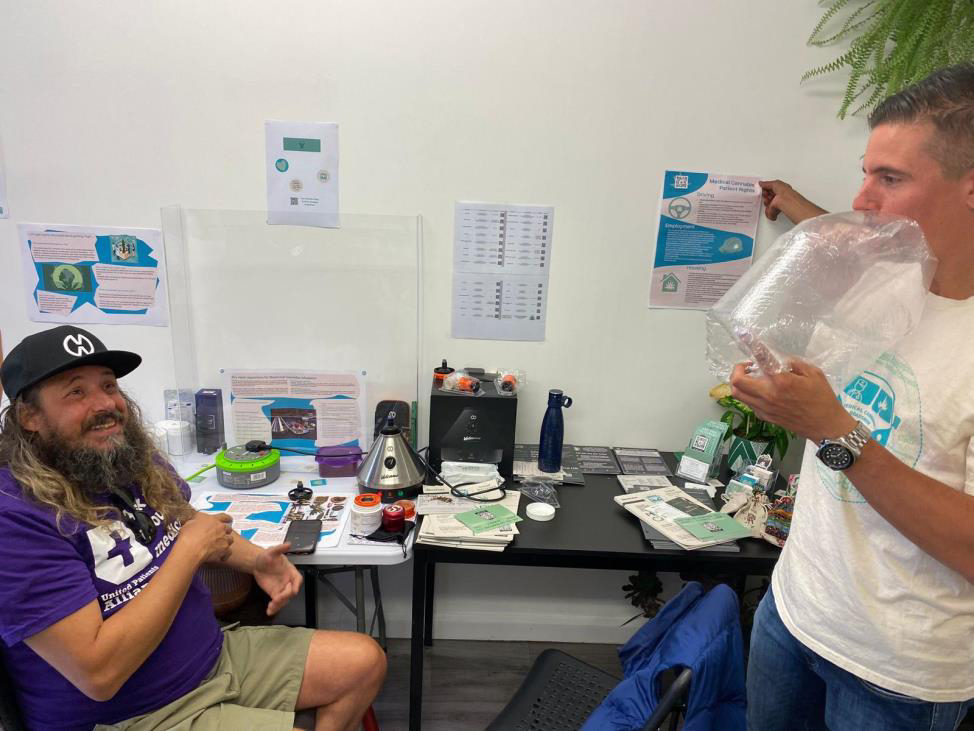
Author uses their prescribed medication after receiving explicit permission to do so despite vaping policies, without needing to prove disability.
Image © PatientsCann UK® CIC 2024Where this leads
Finding common ground
These questions have far reaching consequences for medical cannabis patients. They may affect sport, volunteering, professional licensing, public functions, event access and the development of institutional policy.
The Equality Act is indispensable, but it cannot decide every moral question. It protects qualifying disabled people in specified relationships. It does not declare every patient disabled, cover every volunteer or turn every unkind decision into unlawful discrimination.
That should not be an invitation to search for loopholes. It should be an invitation to build better standards.
Organisations have legitimate responsibilities for safety, competence and the protection of others. Patients have an equally legitimate expectation that lawful treatment will not be confused with misconduct, intoxication or illicit drug use. Those positions are not irreconcilable.
Common ground begins with evidence, individual assessment and compassion. The question should not be, "How little does the law require us to do?"
It should be, "If this adjustment is safe, reasonable and available, why would we refuse it to any lawful patient?"Sal Aziz, Director, PatientsCann UK®
References and further reading
References follow the Harvard style. Legislation is cited by its short title and provision.
Primary legislation
- Equality Act 2010. The principal equality legislation applying in England, Wales and Scotland.
- Equality Act 2010, section 6: Disability. Defines disability as a physical or mental impairment having a substantial and long-term adverse effect on a person's ability to carry out normal day-to-day activities. It also extends protection, in most contexts, to people who have previously had a disability.
- Equality Act 2010, Schedule 1: Disability, supplementary provision. Contains the supplementary rules governing long-term and recurring effects, medical treatment, severe disfigurement, progressive conditions, certain automatically protected conditions and past disabilities.
- Equality Act 2010, Schedule 1, paragraph 2: Long-term effects. Provides that an effect is long-term if it has lasted, or is likely to last, at least 12 months, or is likely to last for the remainder of the person's life. It also addresses recurring effects.
- Equality Act 2010, Schedule 1, paragraph 5: Effect of medical treatment. Requires the effect of an impairment generally to be assessed as though measures being taken to treat or correct it were not operating. "Measures" expressly include medical treatment.
- Equality Act 2010, Schedule 1, paragraph 5A: Normal day-to-day activities in working life. For specified employment-related provisions, the concept includes a person's ability to participate fully and effectively in working life on an equal basis with other workers. This provision took effect on 1 January 2024.
- Equality Act 2010, Schedule 1, paragraphs 6 and 8: Certain medical and progressive conditions. Cancer, HIV infection and multiple sclerosis are treated as disabilities. Separate rules apply to progressive conditions that are likely to result in a qualifying impairment.
- Equality Act 2010, section 13: Direct discrimination. Defines direct discrimination as less favourable treatment because of a protected characteristic. Section 13(3) confirms that a non-disabled person is not directly discriminated against merely because disabled people are treated more favourably.
- Equality Act 2010, section 15: Discrimination arising from disability. Covers unfavourable treatment because of something arising in consequence of disability, subject to objective justification and the statutory knowledge defence.
- Equality Act 2010, section 19: Indirect discrimination. Addresses provisions, criteria or practices that place people sharing a protected characteristic, and the claimant personally, at a particular disadvantage, unless objectively justified as a proportionate means of achieving a legitimate aim.
- Equality Act 2010, sections 20 and 21: Reasonable adjustments. Section 20 sets out the three requirements comprising the reasonable-adjustment duty. Section 21 provides that a failure to comply with the duty constitutes discrimination.
- Equality Act 2010, sections 28 to 31 and Schedule 3: Services and public functions. Section 29 prohibits discrimination in the provision of services to the public or a section of the public, whether the service is provided for payment or without payment. It also covers certain public functions and imposes a reasonable-adjustment duty. Schedule 3 contains specific exceptions.
- Equality Act 2010, section 39: Employees and applicants. Prohibits discrimination in recruitment, employment terms, access to promotion, transfer, training and other benefits, dismissal and other employment detriments. It also applies a reasonable-adjustment duty to employers.
- Equality Act 2010, sections 53 and 54: Qualifications bodies. Protects applicants and holders of relevant professional or trade qualifications and imposes a reasonable-adjustment duty. Section 53(7) provides special treatment for competence standards, which may still be challenged through indirect discrimination.
- Equality Act 2010, sections 101 to 107 and Schedules 15 and 16: Associations. Part 7 regulates discrimination involving membership, associates and guests. Under section 107, an "association" must ordinarily have at least 25 members, with admission regulated by rules and involving a process of selection.
- Equality Act 2010, section 136: Burden of proof. Provides that, where facts are established from which a court could decide that a contravention occurred in the absence of another explanation, the court must find a contravention unless the respondent shows otherwise.
- Equality Act 2010, section 149: Public sector equality duty. Requires public authorities, and other persons exercising public functions in relation to those functions, to have due regard to eliminating prohibited conduct, advancing equality of opportunity and fostering good relations.
- Equality Act 2010, Schedule 9: Work exceptions. Contains specific exceptions relating to work, including occupational requirements and the exclusion of disability and age protection from service in the armed forces under Part 5.
- Equality Act 2010, Schedule 3: Services and public-functions exceptions. Contains detailed exceptions concerning matters including Parliament, legislation, judicial functions, the armed forces, security services, education, health, transport and insurance. The application and scope of each exception depend on its precise wording.
- Equality Act 2010 (Disability) Regulations 2010, SI 2010/2128. These Regulations address matters including excluded conditions, addiction, tattoos and piercings, young children and deemed disability.
- Equality Act 2010 (Disability) Regulations 2010, regulation 3: Addictions. Provides that addiction to alcohol, nicotine or another substance is generally not treated as an impairment, but creates an exception where the addiction initially resulted from medically prescribed drugs or other medical treatment.
- Equality Act 2010 (Disability) Regulations 2010, regulations 4 and 5. Identifies certain conditions that are not treated as impairments and addresses tattoos and non-medical piercings in the context of severe disfigurement.
Case law
- X v Mid Sussex Citizens Advice Bureau and another [2012] UKSC 59. The Supreme Court held that the unpaid volunteering arrangement before it, which did not create a legally binding contract, was not covered as employment or occupation under the applicable disability-discrimination legislation. The case concerned the Disability Discrimination Act 1995, but remains important when considering the absence of general employment protection for genuine volunteers under the Equality Act 2010.
Statutory guidance and codes
- Equality and Human Rights Commission, Code of Practice for Services, Public Functions and Associations. Explains the operation of the Equality Act in relation to service providers, persons exercising public functions and associations. The Code can be used in legal proceedings, and courts and tribunals must take relevant parts into account.
- Equality and Human Rights Commission, Appendix: The meaning of disability in the Equality Act 2010. Provides detailed guidance on impairments, substantial and long-term adverse effects, treatment, recurring conditions, progressive conditions and conditions that receive automatic protection.
- Equality and Human Rights Commission, Equality Act 2010: Summary Guidance on Employment. Provides practical guidance regarding equality law in employment and includes discussion of how organisations should approach volunteers even where ordinary employment protection may not apply.
Explanatory and supplementary material
- Equality Act 2010 Explanatory Notes, section 6. Government explanatory material describing the purpose and effect of the statutory definition of disability and providing illustrative examples. Explanatory Notes assist understanding but do not form part of the Act.
- UK Supreme Court, press summary and judgment in X v Mid Sussex Citizens Advice Bureau. The official Supreme Court materials provide the authoritative context, facts and reasoning concerning the position of the volunteer in that case.
