
In a significant step forward for workplace rights, the UTAW Tech Workers Branch of the CWU has passed a comprehensive motion to improve protection, understanding, and support for workers prescribed cannabis-based products for medicinal use (CBPMs). The motion, moved by Sal Aziz, a member of the branch, reflects the growing recognition that medical cannabis patients face unique and often misunderstood challenges in the workplace.
Although CBPMs have been legally prescribable in the UK since 2018, many employers, and even HR teams, still lack awareness of what prescribed medical cannabis is, how it is used, and what responsibilities employers have toward prescribed patients. This knowledge gap often results in stigma, intrusive questioning, mishandled drug testing policies, and unfair treatment. For many patients, this creates a stressful and sometimes hostile working environment.
What the UTAW Motion Commits To
The motion passed by UTAW directly tackles this by committing the union to:
Raising awareness and combating stigma
The branch will produce and circulate clear, accessible information to members explaining what CBPMs are, how they differ from illicit cannabis, and how stigma affects patients at work. Public support is vital: when unions speak clearly, patients are less likely to hide their prescriptions or fear coming forward when problems arise.
Supporting reps and strengthening workplace protections
Reps will receive guidance on how to support members prescribed CBPMs, including handling discrimination or misunderstanding, advising on reasonable adjustments, and maintaining confidentiality. This is crucial, because many conditions treated with CBPMs may fall under the Equality Act, meaning employers may have duties to accommodate the worker rather than penalise them.
Addressing drug-testing issues responsibly
Drug testing is often the flashpoint for discrimination. Many employers’ policies treat any positive THC result as misconduct, even where a member is taking legally prescribed medication. UTAW’s motion recognises this and calls for clear, fair, evidence-based approaches, ensuring that prescribed medication is not confused with illicit use and that test results, which are sensitive health data, are handled lawfully and respectfully.
Working with PatientsCann UK and other patient-led groups
The motion formally commits UTAW to building relationships with PatientsCann UK and other organisations who specialise in supporting medical cannabis patients. This collaboration will help unions ensure their guidance aligns with lived experience, clinical realities, and practical workplace needs.
Engaging through the Labour Party political link
Recognising that workplace protections are shaped by political understanding, the motion also directs UTAW to work through the CWU’s political link to the Labour Party. Ensuring policymakers better understand the realities of prescribed CBPM use helps create a climate where employers cannot justify discriminatory practices through outdated stereotypes.
Public Support and Normalising Medical Cannabis
A key part of the motion is the commitment to issue a public statement affirming that:
CBPMs have been legal on prescription since 2018
Workers deserve fair and equal treatment when using prescribed medication
Medical cannabis should be treated like any other controlled medicine
Stigma has no place in the modern workplace
This public stance is more than symbolic, it helps shift culture and reassures patients that their union stands with them.
A Step Forward for Patients, and a Model for Others
PatientsCann UK warmly welcomes UTAW’s leadership. This motion sets a powerful example of how unions can address stigma, protect patient rights, and ensure fair treatment. As more workers receive medical cannabis prescriptions, employers, unions, and policymakers must all raise their understanding and adapt outdated assumptions.
Get Yourself Protected, and Protect Other Patients!
If you are a medical cannabis patient, or simply someone who values strong workplace protections for patients, we encourage you to join UTAW, the CWU, or another trade union you are eligible for. Being a union member ensures you are not alone when navigating workplace challenges, and it strengthens the collective voice pushing for fair treatment for all prescribed patients.
Together, we can continue turning lived experience into workplace rights, and challenge the stigma that too many patients still face.
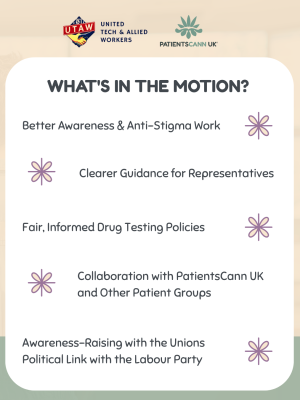
The Full Motion
UTAW notes:
Cannabis-based products for medicinal use in humans (CBPMs) have had a legal route for prescription in the UK since 1 November 2018, under strict controls, including rescheduling relevant products to Schedule 2.
Despite this, there remains widespread misunderstanding and stigma in workplaces, where prescribed CBPM use is often wrongly conflated with illicit cannabis use.
Many people prescribed CBPMs do so for long-term health conditions which may meet the Equality Act definition of disability, meaning employers may have duties relating to non-discrimination and reasonable adjustments.
Workplace drug testing and “drugs and alcohol” policies can create risks of unfair treatment where they do not account for prescribed medications, and drug test results are sensitive health data requiring lawful and fair handling.
UTAW believes:
Workers using lawfully prescribed medication should not face stigma, discrimination, or inappropriate disciplinary action because of misunderstanding about that medication.
Where a worker’s underlying condition meets the Equality Act definition, employers should engage in an evidence-led process to consider reasonable adjustments and avoid discrimination.
Workplace approaches to impairment and safety should be risk-based and role-specific, including for safety-critical work, rather than based on blanket assumptions.
Union reps should be equipped to support members prescribed CBPMs who face stigma or discrimination, who are seeking reasonable adjustments, or who need support navigating workplace policies, including protecting confidentiality.
UTAW resolves:
To raise awareness among members by producing and circulating a briefing explaining:
the distinction between prescribed CBPMs and illicit cannabis,
the relevance of reasonable adjustments,
the implication of drug testing or “drugs and alcohol” policies in the context of CBPMs
and practical steps members can take if they experience stigma or discrimination. This briefing should signpost reputable resources, including patient-led workplace guidance.
To ensure reps have clear support, guidance and signposting for CBPM-related workplace issues, including handling incidents of stigma or discrimination, supporting reasonable adjustment requests, and advising on confidentiality and disclosure.
To work with the CWU to raise awareness and protections for workers prescribed CBPMs, including sharing this motion and related guidance, and requesting any relevant union guidance or policy activity on prescribed medications, disability rights, and fair workplace drug testing.
To build relationships with patient-led medical cannabis organisations including PatientsCann UK, and other relevant groups producing workplace resources, in order to:
understand common workplace issues faced by prescribed CBPM patients,
improve signposting for members,
and inform our workplace and rep support.
To issue a public statement affirming that:
CBPMs have been legal on prescription since 2018,
we support members’ right to be treated fairly when using lawfully prescribed medication,
we oppose stigma and discrimination,
and we support evidence-led, risk-based workplace approaches and reasonable adjustments where relevant.
To work through the union’s political link to raise awareness of the workplace and legal issues faced by workers prescribed cannabis-based products for medicinal use within the Labour Party, with a view to improving understanding, protection, and support for prescribed patients.
Amendment: Yes, and…
Additionally Notes.
The law and social context around substance use and dependency is complex and it would be both impractical and counter to the welcome purpose of the main motion to sketch a full policy position through the medium of footnotes.
The significant challenges our members face in access to care and medicine in relation to neurodivergence, gender dysphoria, and a variety of other experiences.
Nevertheless, Additionally Believes.
A simple dichotomy between medical prescription and other modes and motivations for acquiring psychoactive and other substances collapses the complexity of the world our members live in and would be at odds with supporting those of us who struggle to access medicine through formal channels, even where entirely legal.
Additionally Resolves.
To do nothing in the aid of the main motion via words or action in a way which creates or reinforces – explicitly or implicitly – any moral or social hierarchy of acceptable use of medicines or other substances.

