Endocannabinoid System
PatientsCann UK | The Endocannabinoid System Visualizer Skip to content Science Interactive Peer reviewed sources The endocannabinoid system, explained by exploring your own body Every person reading this has an endocannabinoid system. It is a network of tiny switches, messengers and clean-up crews that keeps the body steady. Tap any part of the body below to see which switches sit there and what they do. PatientsCann UK Education, physiology Written for patients, carers and clinicians On this page The basics Body map How the signal works Makers and breakers What it balances Plant compounds Entourage effect Beyond CB1 and CB2 For clinicians Test yourself References What this page is, and is not This page teaches the science of how the body works. It is not medical advice and it does not recommend any product, dose or treatment. If you think medical cannabis might help you, speak to your GP, your specialist or a clinic on the General Medical Council register. Why this matters It is already yours The system is built into every human body from the first weeks in the womb. Cannabis did not put it there. It keeps you steady Sleep, appetite, pain, mood, movement, temperature and the immune response all get nudged back towards the middle. It is very old Versions of this system appear in animals going back around 450 million years, which is why it is found in so many species. It explains the effects Cannabis compounds work because they fit switches your body already has. Different switches, different effects. Start here Three parts, one job: keeping you steady Your body is a colony of billions of cells. Each cell has its own needs, and they all have to work together. To do that, cells send each other chemical messages. The endocannabinoid system, often shortened to ECS, is one of those messaging networks. Scientists often describe it as a lock and key. The receptor is the lock, sitting on the outside wall of a cell. The messenger molecule is the key. When the right key turns the right lock, something changes inside that cell. The three parts The locks (receptors). Two main ones, called CB1 and CB2. They sit on cell surfaces all over the body and each one changes what its cell does. The keys (endocannabinoids). Fatty messenger molecules your body builds itself. The two main ones are anandamide and 2-AG. The clean-up crew (enzymes). Tools that build the keys when they are needed and destroy them seconds later. The main destroyers are called FAAH and MAGL. The part that surprises people Most messaging systems keep a stock of messengers ready in tiny bags, waiting to be released. The ECS does not. Endocannabinoids are made on demand, cut fresh out of the fatty wall of the cell at the exact moment they are needed, used on the spot, and then broken down. Nothing is stored and nothing travels far. That is why the ECS is so precise. It does not act on the whole body at once. It acts in one small place, for a short time, only where something needs correcting. The word for it is homeostasis. It means keeping the inside of your body steady even when things outside change. Not too hot, not too cold. Not too much pain signal, not too little. The ECS is one of the body’s main tools for doing that. Where the plant comes in The keys your body makes fit the locks perfectly. Compounds from the cannabis plant, called phytocannabinoids, are shaped closely enough to fit the same locks, but they are not identical. Researchers sometimes call them a false key. They turn the lock, but not in quite the same way, not in the same place, and not for the same length of time. That single idea explains almost everything else on this page. Cannabis does not create new effects in the body. It leans on a control system that is already running. It is not the cannabis plant that has many effects, it is the endocannabinoid system that determines them. Dr Mariano Garcia de Palau, Fundacion CANNA Interactive body map Where the receptors are, and what they do there Tap a numbered marker on the body, or a name in the row underneath. CB1 markers are green, CB2 markers are purple, and places with a real mix of both are teal. Show Everything CB1 only CB2 only 13 regions to explore CB1 CB2 Both, in real numbers A note on the drawing. The illustration shows the main organs from the front. Each marker sits over the area that region covers, so a few point at parts that sit deeper in the body. The immune marker sits on a cluster of lymph nodes, and nerves and skin reach everywhere, so those markers show one place out of many. Step by step How one nerve cell tells another to calm down Nerve cells talk across a tiny gap called a synapse. Normally messages travel one way. The ECS is unusual: its message travels backwards. Step through it below. Presynaptic sending neuron Postsynaptic receiving neuron the synaptic gap vesicles CB1 receptor on the sending cell receptors glutamate or GABA Ca2+ up DAGL 2-AG cut from the cell wall backwards fewer messages sent MAGL broken down in seconds Back Next step Why the backwards direction matters. The cell that is getting too much noise is the one that turns the volume down, at the exact synapse where the noise is coming from. Nothing else in the body is affected. This is called retrograde signalling, and it is the reason cannabinoids can quieten over-firing nerves without shutting the whole nervous system down. The cast The makers, the messengers and the breakers Six molecules do most of the work. Two carry the message, two build them, two destroy them. Tap any name. The others, in brief Anandamide and 2-AG get the attention, but the body makes more: Noladin ether and virodhamine, both weaker relatives. Virodhamine may work against
Seed To Patient
Skip to the explorer PatientsCann UK · Patient education From Seed to Patient: the UK medical cannabis pipeline Every legal prescription in the UK travels the same route: a controlled growing room, a licensed factory, an accredited laboratory, a border, a specialist clinic and a pharmacy. This explorer walks you through all six stages, compares the seven formats a patient can be prescribed, and shows you how to read the paperwork that proves it. 6 regulated stages 7 patient formats Quality and science inspector This is education, not medical advice. Onset and duration figures are typical ranges reported for each route. Your own response depends on your dose, your product and your body. Never change how you take your medicine without speaking to your prescriber or pharmacist. See all patient resources 1 The seed to shelf journey 2 Formats and delivery pathways 3 Quality and science inspector The six stages of a legal UK prescription Select any stage to open the detail. Each one has its own quality standard and its own regulator, and a batch cannot move forward until the stage before it has been signed off. 1Genetics and GACP growing 2GMP processing and extraction 3Laboratory testing and CoA 4Licensed import and border 5Specialist prescribing 6Pharmacy dispensing Stage 1 of 6 1 Genetics, breeding and GACP cultivation Where the medicine starts: a known plant, grown the same way every time. Standard GACPRegulator DEFRA and origin inspectors What happens here A licensed grower keeps a small number of mother plants and takes cuttings from them, often through tissue culture, so that every crop is genetically the same plant rather than a new cross. Growing rooms are closed loop: light, temperature, humidity, carbon dioxide and air filtering are all controlled and logged. Mother plant care and cutting or tissue culture cloning Batch to batch genetic stability, checked crop by crop Sealed rooms with filtered air and monitored water feeds Quality standard GACP (Good Agricultural and Collection Practice). It sets how the plant is grown, fed, harvested and handled. In practice it means no synthetic pesticides, and soil, water and fertiliser chosen so the plant does not draw heavy metals up into the flower. Where the flower is dispensed as it is, GACP alone is not enough: the maker has to write down the point at which production of the active substance begins, and for whole flower that point is the growing room. Who regulates it DEFRA in the UK, alongside the agricultural inspectors of the country the crop is grown in. Growers are inspected and have to keep records for every batch they release. One decision sets the whole rulebook What the crop is going to become decides where pharmaceutical rules start. It is the single most important point in the chain, and the one most often got wrong. If the flower itself is the medicine The plant is the active substance Propagation Cultivation and flowering Harvest, drying, curing Packed flower, dispensed as it is Annex 2, biological medicines Nothing downstream can purify or sterilise a dried bud, so quality has to be built in from the cuttings onward. Annex 2 recognises that manufacture can begin at propagation. If the flower will be extracted The plant is a starting material Propagation Cultivation and flowering Harvest and drying Extraction and formulation Annex 7, herbal starting materials Here quality is defined later. Extraction, filtering and purification can take impurities out, so the plant is grown under GACP and pharmaceutical rules begin at the processing step. Why sameness matters A prescription only works as medicine if the next jar behaves like the last one. Controlled genetics and controlled rooms are what let a pharmacist put a fixed cannabinoid percentage on a label. Illicit supply has none of this: the same street name can be a different plant, grown a different way, with a different strength every time, and nobody has tested it. Next: GMP processing 2 Pharmaceutical processing and GMP extraction The crop becomes a pharmaceutical product in a cleanroom. Standard EU and UK GMPRegulator MHRA What happens here Harvested flower is dried and cured at a set temperature and humidity, then milled to a controlled particle size for vaporising. For oils and cartridges the plant material goes through supercritical carbon dioxide extraction, then winterisation to strip out fats and waxes, with any solvent recovered and accounted for. Controlled drying, curing and precision milling Cold carbon dioxide extraction under pressure Winterisation, filtration and solvent recovery Standardising the extract to a fixed cannabinoid strength Quality standard EU and UK GMP (Good Manufacturing Practice). Work happens in cleanrooms with ISO class 5 and class 7 air handling and positive air pressure, so air always flows out of the clean space rather than into it. Every step is written down, signed and traceable to the batch. The rulebook is EudraLex Volume 4: Part I for finished medicines, Part II for active substances, and Annex 2 for medicinal cannabis intended for use as whole flower. Quality risk management sits across all of it. Who regulates it The MHRA, the UK medicines regulator. A site that makes or releases a medicine for UK patients has to hold and keep its GMP certification through inspection. Three routes out of the same growing room Where GACP stops and GMP starts depends on what the batch is going to become. Requirements tighten at every step closer to the patient. GACP, pre harvestGMP, post harvestGood distribution practice Bulk flower for extractionMother plantsRooting and hardeningLarge scale cultivationharvestFast fan assisted dryingMachine trimmingBulk packaging and shippingExtractionActive ingredientFormulationFilling and packaging Sold on as feedstock, so the later GMP steps happen at another site. Extracts, including oils, hash and rosinMother plantsRooting and hardeningLarge scale cultivationharvestFast dryingMachine trimmingExtractionActive ingredientFormulationFilling and packagingDistribution Processing can remove impurities, so the finished extract is standardised before it is filled. Finished packaged flower (Flos)Mother plantsRooting and hardeningSmall scale cultivationharvestWet hang harvestSlow cool dryingHand trimmingCuringPackagingDistribution Covered end to end by GMP Annex 2. The flower itself is the finished medicine, so nothing can be cleaned out of it
Cannabinoids
Cannabinoids Explained: THC, CBD, CBG, CBN & More | PatientsCann UK Skip to the cannabinoid library PatientsCann UK · Education Understanding Cannabinoids Cannabinoids are the active compounds in cannabis. They are the reason a cannabis medicine can ease pain, calm the mind, or help with sleep. This guide explains what they are, how they work in your body, and why heating the plant changes everything. 13 cannabinoids Interactive receptor map Accurate chemical structures Plus THC metabolism On this page What are cannabinoids? How they work Raw vs heated In your body THC vs CBD The family Questions References What are cannabinoids? Cannabinoids are a family of natural compounds made by the cannabis plant. Scientists have found more than 100 of them. They are the part of the plant that makes it useful as a medicine. Each cannabinoid has its own job. THC eases pain and sickness but also causes the “high”. CBD is calming and does not make you high. Others, like CBG and CBN, are being studied for focus, sleep and much more. Your body already makes its own cannabinoid-like chemicals. Plant cannabinoids work by borrowing the same network in your body. Scientists call it the endocannabinoid system, or ECS for short. Cannabinoids rarely work alone Alongside the aroma compounds called terpenes, cannabinoids seem to work better together than apart. Scientists call this the “entourage effect”. It is one reason a whole-plant medicine can feel different from a single pure cannabinoid. Learn more on our terpenes guide. Interactive How Cannabinoids Work in the Body Your endocannabinoid system has two main “locks”, called receptors: CB1 and CB2. Cannabinoids are the “keys”. CB1 sits mostly in the brain and nerves. CB2 sits mostly in the immune system and around the body. Pick a cannabinoid below to see which locks it fits, and what that might mean for you. None Weak / indirect Partial Strong Dampens / blocks Interactive Raw vs Heated: Why Cannabis Must Be Warmed Here is something that surprises most people: raw cannabis will not get you high. The plant does not make THC or CBD directly. It makes their acid forms first, called THCA and CBDA. Only when you add heat, by vaping, smoking or cooking, do these acids lose a tiny piece (a carbon dioxide molecule) and turn into THC and CBD. This is called decarboxylation. Follow the pathway, tap any molecule to see its structure, then press Apply heat. Apply heat The plant makes acids (left). Heat turns them into the cannabinoids you know (right). Mother acid (CBGA) Acid form (raw) Neutral form (after heat) Interactive In Your Body: What Happens to THC Heating the plant makes THC, but the story does not end there. Once THC is inside you, your liver changes it step by step into new molecules. One of them is stronger than THC itself. This is the hidden reason an eaten edible can feel so different from a vape, and why the same dose can affect two people in completely different ways. The key player 11-Hydroxy-THC is a metabolite: a new molecule your body makes while breaking THC down. It is not in the plant. It fits the CB1 receptor even better than THC, so it is stronger and reaches the brain more easily. Does the route change things? Try it Inhaled (vape or smoke) Eaten (edible) Inhaled: mostly THC reaches your brainRough share of active cannabinoid in your blood THC11-OH Delta-9-THC11-Hydroxy-THC (stronger) Fast and lighter. Inhaled THC goes almost straight to your brain, mostly unchanged. Very little becomes 11-hydroxy-THC. Onset is quick (minutes) and the effect fades sooner. The breakdown pathway Full profiles:11-Hydroxy-THC THC-COOH Why edibles feel stronger When you eat cannabis, most of the THC is turned into 11-hydroxy-THC before it reaches your bloodstream. A gentle vape and an intense edible can come from the very same flower. (Huestis, 2007) Why they fail for some Everyone’s liver runs at a different speed. The main enzyme, CYP2C9, comes in different genetic versions, so blood levels from the same dose vary widely between people. (Sachse-Seeboth et al., 2009) A fast liver can rush THC through to the inactive THC-COOH and clear it before much is felt, so a normal edible seems to do nothing. Where nano-emulsions help Nano-emulsified edibles wrap THC in tiny food-safe droplets, so more is absorbed, faster, and some slips past the liver’s first pass. They do not make THC more powerful; they make the dose more reliable. (Hermush et al., 2025) Patients first: because bodies differ so much, never chase an edible with a second dose too soon; give it up to two hours. Ask your prescriber which format and strength suit you best. At a glance THC vs CBD: The Two You Hear About Most THC and CBD come from the same plant and look almost identical under a microscope, yet they behave very differently in the body. Here is the simple version. THC Delta-9-tetrahydrocannabinol Makes you high? Yes. It switches on CB1 in the brain. Mainly used for Pain, muscle spasm, nausea, appetite and sleep. How it works Directly activates the CB1 and CB2 receptors. UK status Prescription only, from a specialist doctor. Watch for Anxiety, a racing heart or dizziness at higher doses. CBD Cannabidiol Makes you high? No. It barely touches CB1. Mainly used for Anxiety, epilepsy, inflammation and calm. How it works Acts mostly on other targets, and softens THC. UK status Low-THC CBD sold as a supplement; medical CBD is prescribed. Watch for Usually well tolerated; can interact with some medicines. Full library The Cannabinoid Family Select any card to open the full profile, with its accurate chemical structure, how it works, what the research says, and safety notes. Use the filters to narrow the list. Filter: All Non-intoxicating Intoxicating Acidic (raw) Metabolite Sleep Pain Questions Cannabinoids: Your Questions Answered What is the difference between THC and CBD? THC is intoxicating: it switches on the CB1 receptor in the brain, which causes the “high” and also eases pain and nausea. CBD
Medical Cannabis Women’s Health
From menstrual pain to menopause, endometriosis to anxiety, a growing body of research and real patient experience is reshaping how women access and use prescribed cannabis in the UK.
UK-First Inpatient Medical Cannabis Policy
Devon Partnership NHS Trust has formally approved CD21, a Standard Operating Procedure that gives medical cannabis patients a clear, safe pathway to continue their lawful prescriptions while admitted to hospital. Here is what it means for you.
Bedrocan May 2026 Press Release
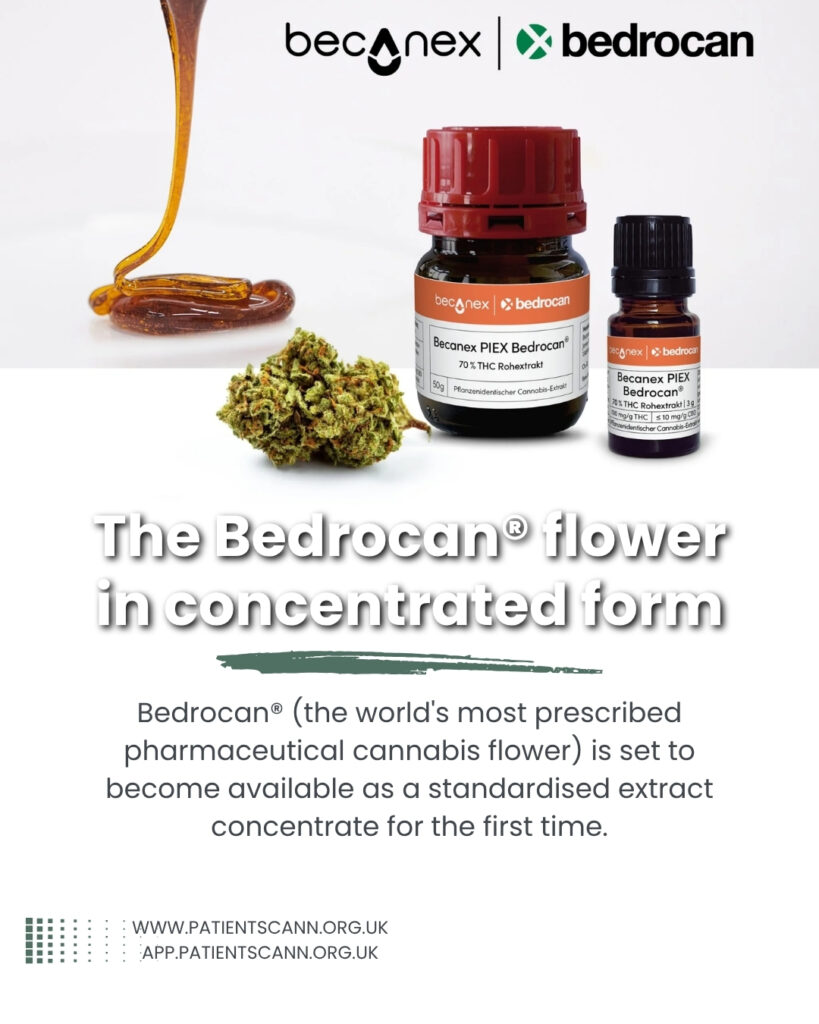
New Bedrocan® Concentrate Opens Up More Ways to Take Your Prescription – PatientsCann UK Skip to main content Industry News · Prescribing Options A trusted flower,now in a new form Bedrocan® — the world’s most prescribed pharmaceutical cannabis flower — is set to become available as a standardised extract concentrate for the first time. For patients, that could mean the same trusted medicine available in more ways than ever before. PatientsCann UK · Industry News · 19 May 2026 Jump to: What Is It? Formulations Why It Matters Timeline 20+ years of Bedrocan® pharmaceutical cannabis production trusted by doctors worldwide 70% THC concentration in the new Becanex PIEX Bedrocan® extract — preserving the full cannabinoid and terpene fingerprint 5+ preparation formats now possible from a single standardised concentrate, from capsules to inhalation 2026 Target launch date for pharmacy ordering across Europe, with Germany as the first market What Is It? The Bedrocan® flower you know — in concentrated form If you have been prescribed Bedrocan® flower, you will know it as one of the most consistent and well-studied pharmaceutical cannabis products available. Grown in EU-GMP-certified facilities in the Netherlands and Denmark by Bedrocan International, it has been the benchmark for standardised medical cannabis for more than two decades. Now, that same product is set to take a new form. Berlin-based extraction specialist Becanex GmbH has developed the Becanex PIEX Bedrocan® 70% THC Concentrate — an extract that, for the first time, brings the full cannabinoid and terpene fingerprint of the Bedrocan® flower into a standardised, pharmacist-ready concentrate. The extract is produced using Becanex’s proprietary PIEX (Plant-Identical Extraction) process, which is specifically designed to preserve what makes a particular cannabis strain therapeutically distinctive. In simpler terms: this is not a generic cannabis extract. It is Bedrocan® in a bottle — the same profile, in a versatile new format. What makes it different from other extracts? Many cannabis extracts are produced to isolate one or two cannabinoids — often just THC or CBD — and discard the rest. The PIEX method takes a different approach, retaining the full spectrum of naturally occurring cannabinoids and terpenes in proportions that match the original flower. Becanex describes this as “a fingerprint” of the source material, and that precision matters clinically: the interaction between cannabinoids and terpenes — sometimes called the entourage effect — is increasingly recognised as relevant to therapeutic outcomes. The result is a concentrate that is both highly potent (at 70% THC) and pharmacologically familiar to doctors and pharmacists who have already been prescribing Bedrocan® flower. “We have always been precise about how we grow our cannabis. Becanex is equally precise about how they extract it. That shared attention to detail is what makes this product worth putting in front of pharmacists, prescribers and patients. The concentrate now enables doctors to prescribe our main product Bedrocan® in multiple compounding formulations.” Jaap Erkelens — CEO, Bedrocan International Formulations More ways for pharmacists to prepare your medicine One of the most significant implications of this product for patients is flexibility. A standardised concentrate that sits in a pharmacy’s dispensary can be compounded into a wide range of preparation formats, tailored to what works best for each individual. The Becanex PIEX Bedrocan® concentrate is specifically designed for the following preparations: Oral solution Capsules Suppositories Topical forms Inhalation dosage Vaporisation What this means in practice for patients For patients currently prescribed Bedrocan® flower, this is particularly significant. If inhalation becomes difficult — whether due to respiratory concerns, lifestyle factors, or simply personal preference — a concentrated extract from the same strain could potentially be offered as an oral or capsule-based alternative, without switching to an entirely different product. The vaporisation option is also noteworthy: the concentrate can be vaporised directly, giving patients an additional inhalation route alongside the flower. This kind of flexibility within a single, consistent product profile is exactly the kind of development that helps both patients and prescribers make evidence-informed adjustments over time. It is important to note that any change to your prescription formulation must always be discussed with and authorised by your prescribing specialist. The availability of a new format does not mean your prescription changes automatically — it expands the options your clinician can consider for you. “Patients who have found a cannabis strain that works well for them shouldn’t have to compromise if they need it in a different form. With Bedrocan as our partner, we can now offer prescribers exactly that — building on a strain they already know and trust.” Sebastian Kamphorst — Director, Becanex GmbH Why It Matters Why standardisation matters for patients Consistency you can rely on One of the greatest frustrations for patients on prescribed cannabis is variability. A standardised extract — manufactured under GMP conditions from a named, controlled cultivar — reduces that uncertainty. You and your prescriber know what to expect. No need to start from scratch For patients and doctors who have already found that Bedrocan® works, this product preserves that relationship. Switching formulation format does not mean re-establishing which strain or cannabinoid profile is therapeutically appropriate. Pharmacist flexibility Compounding pharmacies are central to how many patients receive their prescribed cannabis. A concentrate designed specifically for compounding gives pharmacists more tools to prepare bespoke preparations that suit individual clinical needs. Germany first, Europe next Germany is the first market for the launch, which reflects its position as the most developed regulated medical cannabis market in Europe. UK patients should watch this development closely — it signals the direction of travel for product diversity across Europe. A decade in the making This collaboration is not simply a commercial arrangement — it has roots going back more than ten years. As early as 2014, the founding team behind Becanex worked with Bedrocan under a scientific licence to develop the first extracts from the Bedrocan® flower. At the time, the regulatory framework to bring such a product to market did not exist. Today, it does. Kamphorst reflects on this directly: the team is not
Prescription Direction in Medical Cannabis: Guidance for Clinicians and Patients
Prescription Direction in Medical Cannabis: Guidance for Clinicians and Patients – PatientsCann UK Skip to main content Education GMC Guidance Aligned CQC Standards Prescription Direction in Medical Cannabis:Guidance for Clinicians and Patients In the UK, most medical cannabis, legally termed cannabis-based medicinal products (CBPMs), is prescribed by specialists in the private sector. Issues around prescription direction, where patients are steered toward specific pharmacies or restricted product lists, have become critical ethical and professional considerations for the sector. PatientsCann UK · Education & Guidance · Published 23 March 2026 · ~6 min read GMC General Medical Council | Prescribing Standards Aligned with GMC guidance on cannabis-based products for medicinal use (2026) CQC Care Quality Commission Provider expectations for independent CBPM clinics Reviewed February 2026 Jump to Definition Legal Framework For Clinicians For Patients Summary References At a Glance Three principles that underpin this guidance Patient Owns the Prescription Once issued, a valid prescription belongs to the patient — not the clinic. Patients may take it to any appropriately registered pharmacy. Clinical Grounds Only Any direction toward a specific pharmacy or product must be clinically justified. Commercial or operational preferences are not sufficient grounds. Regulatory Accountability Independent CBPM clinics are regulated by the CQC. Professional conduct is subject to GMC oversight. Patients can raise concerns with either body. Definition What is “Prescription Direction”? Key Term ‘Prescription Direction’ refers to any practice in which a healthcare provider influences or obligates a patient to use a particular pharmacy or dispensing service, or restricts which products may be prescribed based on a clinic’s internal formulary rather than clinical considerations alone. For standard prescription-only medicines, and CBPMs alike, once a valid prescription is issued, the patient, not the issuing clinic or prescriber, owns the prescription and has the right to have it dispensed at any appropriate pharmacy. Professional guidance makes no provision for locking prescriptions to a particular dispensing outlet on non-clinical grounds. [1] This issue has grown in practical significance as the UK’s private medical cannabis sector has expanded. Patients, many managing chronic and complex conditions, must be able to access the most suitable products at pharmacies they can practically use and afford. Legal & Regulatory Framework Prescribing medical cannabis in the UK Who Can Prescribe GMC Specialist Register Only CBPMs (excluding those with a marketing authorisation like Sativex®) are predominantly unlicensed medicines. The law restricts their prescription to doctors on the GMC’s Specialist Register, acting within their area of competence. [3] Clinic Regulation Care Quality Commission Independent clinics prescribing CBPMs are regulated by the CQC, which requires clinical governance, prescriber competence, patient safety, informed consent, and compliance with controlled drugs legislation. [4] Pharmacy Supply Any Registered Pharmacy There is no single official UK “list” of pharmacies for CBPMs. Any pharmacy that is properly registered and complies with regulatory standards may dispense them once presented with a valid prescription. [5] Unlicensed Medicines and Clinical Responsibility Unlicensed medicines entail additional responsibilities for prescribers because they have not undergone the full range of regulatory assessments for safety, quality and efficacy. Prescribers must therefore be confident that the product is appropriate for the individual patient, and must explain to patients the unlicensed nature of the treatment as part of informed decision-making. [1][5] Shared Care Arrangements NHS England guidance confirms that while subsequent prescriptions may sometimes be made under shared care arrangements, initial prescriptions must be authorised by a specialist clinician. This reinforces the importance of maintaining robust clinical oversight throughout a patient’s CBPM treatment pathway. [2] Conflicts of Interest The CQC guidance confirms that providers must ensure prescribing decisions are clinically justified, appropriately documented, and made in the best interests of the patient, with systems in place to manage risk and avoid conflicts of interest. This includes ensuring that organisational or commercial arrangements do not compromise professional judgement or patient choice in prescribing or supply pathways. [4] For Clinicians Responsibilities for prescribing doctors Many private medical cannabis clinics operate internal formularies, lists of products they commonly prescribe based on clinician familiarity, supply arrangements, or existing protocols. There may be legitimate clinical reasons to prefer certain products (e.g. formulations with established pharmacological profiles or evidence bases). However, clinicians must never refuse to consider other products solely because they are not on an internal clinic list, without clinical reasoning. [1] Clinical judgement during prescribing must always focus on the patient’s individual needs rather than operational convenience or commercial preference. This is consistent with all prescribing guidance for individualised care. Do’s for Clinicians Respect patient choice of pharmacy — inform patients they may take their prescription to any appropriately registered pharmacy capable of dispensing CBPMs Provide balanced product information — discuss evidence, risks, benefits, and availability of relevant CBPMs to enable informed decision-making Explain formulary limits transparently — if prescribing experience is concentrated on certain products, clarify this and discuss why other products may be clinically appropriate Follow GMC prescribing standards — ensure decisions are based on clinical evidence and patient needs, not commercial relationships [1] Operate within CQC governance expectations — maintain transparency in prescribing practices and avoid commercial influence on clinical decision-making [4] Don’ts for Clinicians Do not require patients to use a particular pharmacy for non-clinical reasons Do not imply that prescriptions are “owned” by the clinic or that patients must dispense through a preferred partner Do not limit prescribing to products on an internal formulary if other products are clinically suitable and available Do not allow commercial arrangements with pharmacies or manufacturers to influence clinical prescribing choices Any practice that restricts patient choice on non-clinical grounds may undermine professional ethics and patient trust. For Patients Your rights as a CBPM patient Know Your Rights What you are entitled to You have the right to choose the pharmacy that dispenses your prescription, provided it is registered and authorised to supply controlled drugs and CBPMs [5] A prescription is your legal document, it may be taken to any suitable registered pharmacy Clinicians must explain the clinical basis for any recommended product, including risks and benefits, to support informed
THCa is it legal?
PatientsCann UK — THCa — Is It Legal? Education Cannabinoids February 2025 THCa — Is It Legal in the UK? Tetrahydrocannabinolic acid (THCa) is a non-psychoactive cannabinoid found in raw cannabis. This guide explains its biochemistry, therapeutic potential, and — critically — its legal status in the United Kingdom. PatientsCann UK·Education·6 February 2025 · Updated March 2026 What Is THCa? THCa is the acidic precursor to THC found naturally in raw cannabis plants. In its unheated form it is non-psychoactive — it does not produce a “high.” The Critical Caveat When heated (smoking, vaping, cooking), THCa undergoes decarboxylation and converts into THC — gaining psychoactive properties. This conversion is legally significant. Therapeutic Potential Emerging research suggests THCa may offer several health benefits in its raw form: Anti-inflammatory properties: may reduce inflammation relevant to arthritis and other inflammatory diseases Neuroprotective effects: may protect nerve cells, with applications in neurodegenerative disorders Antiemetic benefits: may alleviate nausea and vomiting for patients undergoing chemotherapy or with chronic gastrointestinal conditions Legal Status in the UK The ACMD has addressed THCa’s control status in its consumer CBD report. While THCa in its raw state does not produce psychoactive effects, its potential to convert to THC on heating means it sits in a legally complex position under UK law. Important: The legal status of THCa in the UK is not straightforwardly settled. Under the Misuse of Drugs Act 1971, cannabis and its cannabinoids are controlled. THCa products sold outside of a legitimate prescription pathway carry significant legal risk. PatientsCann UK recommends patients only access cannabinoids via licensed clinics and regulated prescribers. Educational Disclaimer This article is for educational purposes only. It is not legal advice. Laws change — always consult a qualified solicitor or your prescribing clinic for guidance specific to your situation. Mohammad Ismail “Ish” Wasway · Managing DirectorPatientsCann UK® · UK’s Medical Cannabis Patient Organisation · patientscann.co.uk
Science Behind Tropical Cannabis Aromas

Recently, scientists made an exciting discovery that sheds light on the chemistry behind those tantalising tropical aromas: Tropicannasulfur compounds (TCSCs).
What is Medical Cannabis
Cannabis Based Medical Products (CBMPs) or Medical Cannabis are medications derived from the cannabis plant
